
Sphere Created from Revolution
Loading the math board and drawing, please wait…
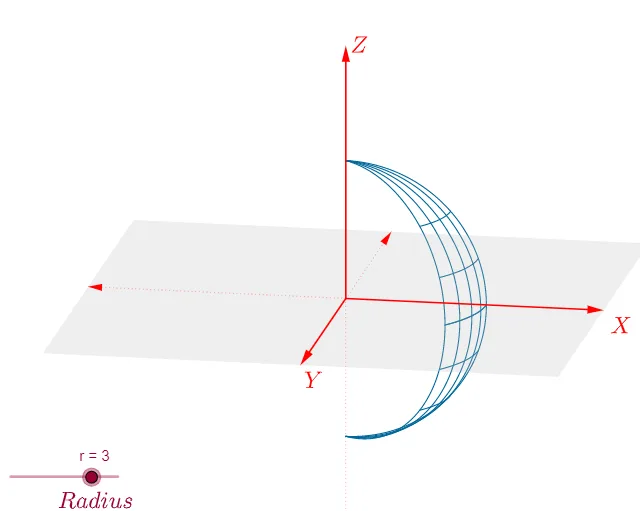
This GeoGebra example demonstrates the creation of a sphere by revolving a two-dimensional shape, such as a semicircle, around an axis, providing a visual representation of solids of revolution. Key mathematical concepts involved include solid geometry, parametric equations, vector algebra, and sequence generation. The construction utilizes commands like Vector to define directional vectors, Polygon to draw the base shape, and Sequence to generate points along the revolution path; objects include various vectors (e.g., E_z, E_y, E_x), polygons (poly1), lists (list1, list2, list3), and text elements (text1 to text5) to model the dynamic process. It is suitable for high school or introductory college courses in geometry and calculus, aiding in the understanding of three-dimensional shapes and their properties.
GeoGebra Commands & Parameters
Vector(((1.1 * d) * W_x)) → uVector(((1.1 * d) * W_y)) → vVector(((1.1 * d) * W_z)) → wPolygon(((1.1 * d) * (W_x + W_y)), ((1.1 * d) * ((-W_x) + W_y)), ((1.1 * d) * ((-W_x) - W_y)), ((1.1 * d) * (W_x - W_y))) → poly1, g, h, i, jSequence(CurveCartesian[x(((r * cos((0.157 * i))) * W_z) + ((r * sin((0.157 * i))) * ((cos((0.157 * j)) * W_x) + (sin((0.157 * j)) * W_y)))), y(((r * cos((0.157 * i))) * W_z) + ((r * sin((0.157 * i))) * ((cos((0.157 * j)) * W_x) + (sin((0.157 * j)) * W_y)))), i, 0, 20], j, 0, p) → list3Sequence(CurveCartesian[x(((sqrt(r^(2) - i^(2)) * cos((0.157 * j))) * W_x) + ((sqrt(r^(2) - i^(2)) * sin((0.157 * j))) * W_y) + (i * W_z)), y(((sqrt(r^(2) - i^(2)) * cos((0.157 * j))) * W_x) + ((sqrt(r^(2) - i^(2)) * sin((0.157 * j))) * W_y) + (i * W_z)), j, 0, p], i, 0, r, 1) → list1Sequence(CurveCartesian[x(((sqrt(r^(2) - i^(2)) * cos((0.157 * j))) * W_x) + ((sqrt(r^(2) - i^(2)) * sin((0.157 * j))) * W_y) - (i * W_z)), y(((sqrt(r^(2) - i^(2)) * cos((0.157 * j))) * W_x) + ((sqrt(r^(2) - i^(2)) * sin((0.157 * j))) * W_y) - (i * W_z)), j, 0, p], i, 0, r, 1) → list2
AI Drawing Prompt Reference
First define three orthogonal unit vectors as coordinate axes, then draw a centered square in the horizontal plane as a base, next generate two families of semicircular curves using parametric equations and revolve them around the vertical axis to form the upper and lower hemispheres, then add a third family of curves along meridians to fill the sphere surface, all curves are produced by sequence commands that create point sets, resulting in a sphere model created by revolving a semicircle.
The prompt above was compiled from the original drawing commands and is for reference only.