
Sphere Construction for Special Relativity: Spatial Velocity Plus Proper-Time Ve
Loading the math board and drawing, please wait…
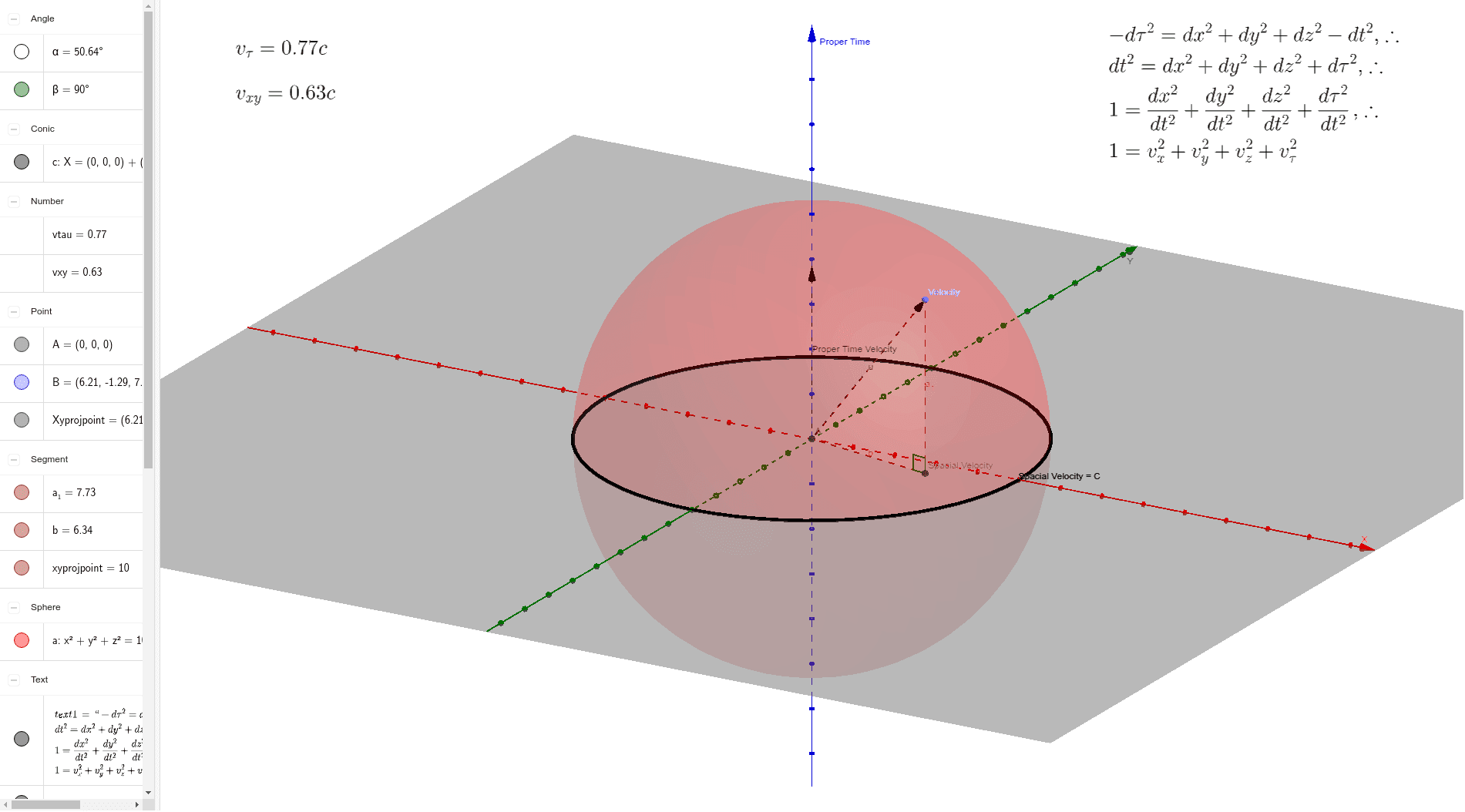
This GeoGebra example uses a 3D sphere and geometric intersections to visually demonstrate the relativistic constraint that combines a spatial velocity component with a proper-time velocity term such that their (constructed) sum remains equal to the speed of light c. It highlights how vector decomposition and norm-based geometry encode physical invariants. Key math ideas include vector projection, angle-based parametrization, and spherical (distance/constraint) geometry, with supporting triangle/polygon structures to organize the construction. In GeoGebra, the model is built with Sphere to create the constraint surface, Intersect to locate relevant intersection points, and PointIn to test point inclusion. Vector and Angle define the velocity directions and the angular parameters (α, β), while Polygon and Circle help form and annotate the geometric regions and auxiliary arcs used for the visualization. The construction relies on direction vectors (xhat, yhat, zhat), their projections (xproj, yproj, zproj, xyproj), and labeled points/objects (e.g., Xyprojpoint, xyprojpoint), together with on-figure annotations for c, vtau, and vxy. Suitable for advanced high-school enrichment and undergraduate physics/mathematics courses focused on geometric modeling of constraints and relativistic interpretations.
GeoGebra Commands & Parameters
Sphere(Intersect[zAxis, yAxis], 10) → aIntersect(xAxis, yAxis) → APointIn(a) → BVector(A, B) → uPolygon(A, B, Xyprojpoint) → poly1, xyprojpoint, a_1, bAngle(B, A, Xyprojpoint) → αAngle(B, Xyprojpoint, A) → βCircle(A, 10, zhat) → c
AI Drawing Prompt Reference
Draw a 3D sphere with its surface showing the relativistic constraint where the sum of a spatial velocity component and proper-time velocity equals the speed of light c, using vector projections and angle-based parameters to highlight physical invariants, with triangles and auxiliary arcs annotating velocity directions, angles α, β, and labels c, vtau, vxy.
The prompt above was compiled from the original drawing commands and is for reference only.