
Spatial Motion Examples: Interactive 3D Curves and Geometric Transformations
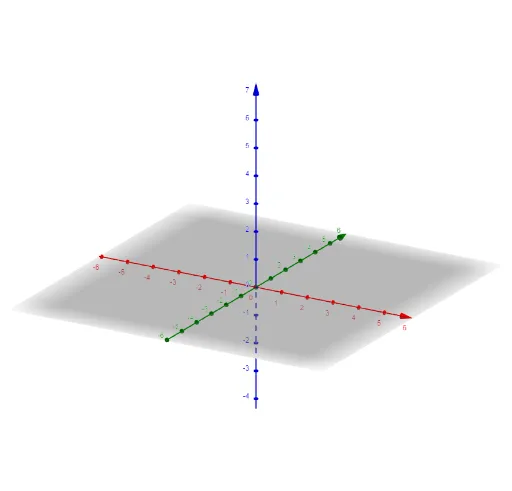
Loading the math board and drawing, please wait…
This example demonstrates spatial motion trajectories and geometric transformations, using 3D curves and interactive buttons to show how related geometric objects (such as length and volume) change as a point moves along a path. Core mathematical concepts include parametric equations of space curves, geometric distribution, straight lines, step functions, volume calculation, and dilation transformations. Construction highlights: the GeoGebra commands CurveCartesian and Length are used to define the 3D curve and compute its length; multiple points (A, C, b, d), text objects (text1 to text7), and five buttons (button1 to button5) are created to control animation playback, reset, or switch between different motion phases. Suitable for high school or early college students to understand spatial analytic geometry, parametric curves, and dynamic geometry interactions, and also serves as a teaching resource for instructors demonstrating spatial motion and transformation relationships.
GeoGebra Commands & Parameters
CurveCartesian(t - ((3 * π) * cos((π * t))), (2 * t) - (π * sin((π * t))), (2 * t), t, 0, (2 * π)) → aCurveCartesian((0.5 * t^(2)) - (3 * sin((π * t))) + 1, t^(2) + cos((π * t)) + 4, t^(2), t, 0, 6) → cCurveCartesian(sin(t), (0.5 * cos(t)), (0.5 * t), t, 0, 100) → bLength(c, 0, 4) → g
AI Drawing Prompt Reference
Create an interactive 3D visualization showing spatial motion trajectories and geometric transformations with three distinct parametric curves, controlled by interactive buttons for animation playback, reset, and switching motion phases, displaying how geometric quantities like length change as a point moves along paths, suitable for understanding spatial analytic geometry and parametric curves.
The prompt above was compiled from the original drawing commands and is for reference only.