
Solving -x^2+6x-13=0 using the quadratic formula and checking
Loading the math board and drawing, please wait…
In collections
UCSS Secondary Math II Unit 3B Lesson 2
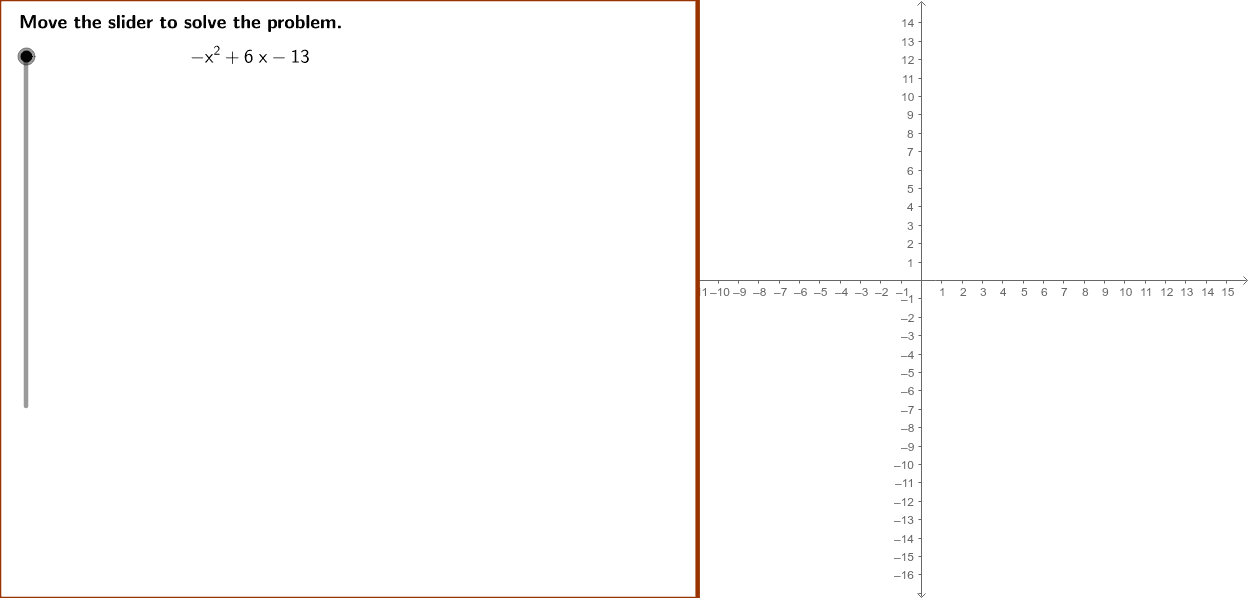
This example demonstrates solving the quadratic equation -x^2+6x-13=0 using the quadratic formula, verifying the solutions, and explaining how the graph of the related function supports the findings. It involves core concepts like the quadratic formula, discriminant, complex roots, and the relationship between function graphs and equation roots. The construction utilizes commands and objects such as GCD, Polygon, Line, Simplify, PrimeFactors, Unique, Length, Sequence, Product, If, Textfield, and ComplexRoot. Suitable for high school mathematics students learning the solution methods of quadratic equations and their geometric interpretations.
GeoGebra Commands & Parameters
GCD(b, denom) → firstGCDPolygon((instructionEdge, y(Corner[1])), (instructionEdge, y(Corner[3])), Corner[4], Corner[1]) → instruction, instructionRight, instructionTop, instructionLeft, instructionBottomLine((x(Corner[1]) + ((2 * indent) * screenwidth), 0), yAxis) → align1Line((x(Corner[1]) + ((3 * indent) * screenwidth), 0), yAxis) → align2Line((x(Corner[1]) + ((4 * indent) * screenwidth), 0), yAxis) → align3Simplify((a * x^(2)) + (b * x) + c) → fPrimeFactors(absDiscriminant) → primeFactorsUnique(primeFactors) → uniqueFactorsLength(uniqueFactors) → numberFactorsSequence(CountIf[x ≟ Element[uniqueFactors, i], primeFactors], i, 1, numberFactors) → factorRepetitionsProduct(Sequence[Element[uniqueFactors, i]^(floor(Element[factorRepetitions, i] / 2)), i, 1, numberFactors]) → outsiderootIf(discriminant < 0, "i", "") → imaginary_1GCD(outsideroot, denom) → secondGCDTextfield(a) → inputBox1Textfield(b) → inputBox2Textfield(c) → inputBox3ComplexRoot(f) → z_1, z_2If(discriminant < 0, "no", If[discriminant > 0, "two", "one"]) → interceptsIf(discriminant < 0, "no real solutions and two imaginary solutions", If[discriminant > 0, "two real solutions and no imaginary solutions", "one real solution and no imaginary solutions"]) → solutions
AI Drawing Prompt Reference
Draw the graph of the quadratic function y = -x^2 + 6x - 13 and solve it using the quadratic formula to find its x-intercepts (if any). Label the discriminant and indicate the nature of the solutions (real or complex) based on its value. Show the geometric relationships related to the solutions in the graph, such as using specific polygons and aligned lines to indicate the positions or properties of the solutions, and use text fields to display the coefficients and discriminant results.
The prompt above was compiled from the original drawing commands and is for reference only.