
Solid Geometry: Volume and Surface Area
Loading the math board and drawing, please wait…
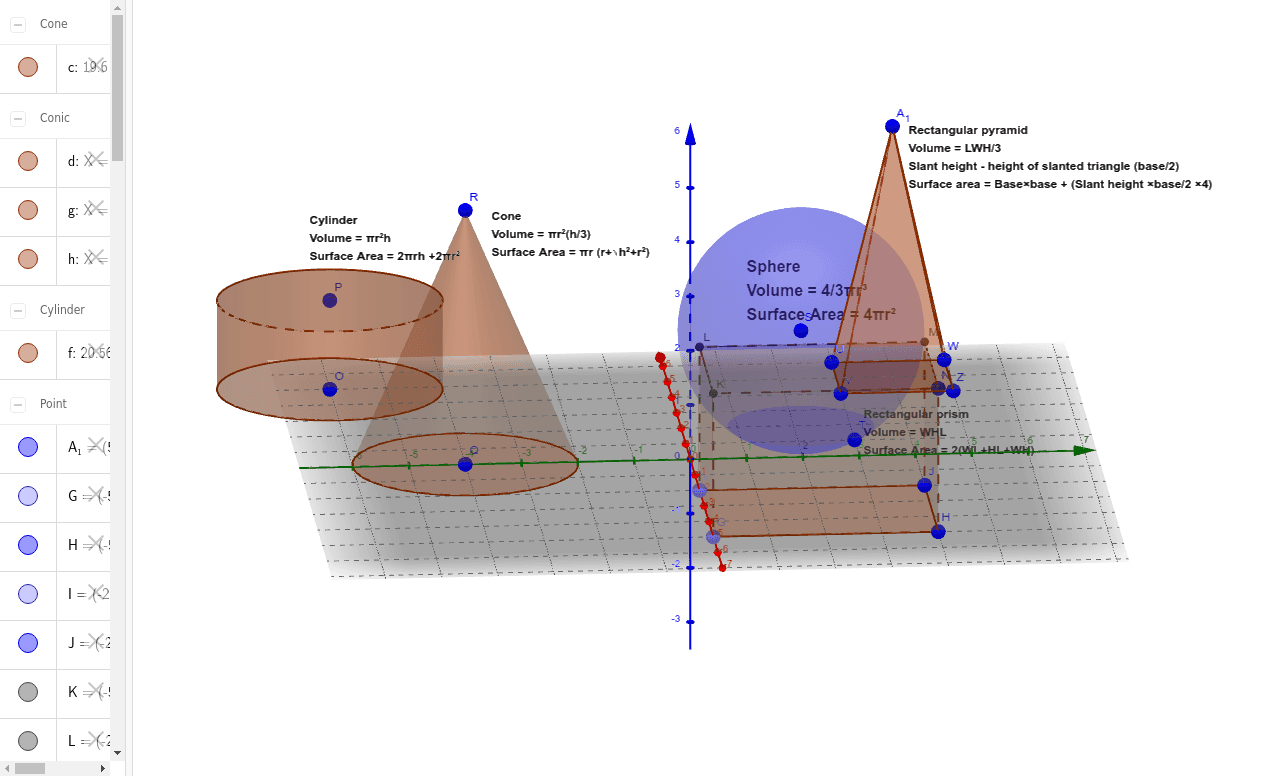
This example demonstrates the concepts of volume and surface area in solid geometry. It constructs prisms, cones, cylinders, spheres, and pyramids to show how to calculate the volume and surface area of these solid figures. Basic geometric objects such as points, edges, and faces are used, along with GeoGebra commands like point, prism, cone, cylinder, sphere, and pyramid. Suitable for middle and high school students learning solid geometry.
GeoGebra Commands & Parameters
Point(xAxis) → GPoint(xAxis) → IPrism(H, G, I, J, N) → b, K, edgeGH, edgeGI, edgeIJ, edgeHJ, edgeHN, edgeGK, edgeIL, edgeJM, edgeKN, edgeKL, L, edgeLM, edgeMN, M, faceGHJI, faceGHNK, faceGILK, faceIJML, faceHJMN, faceKLMNCone(Q, R, 2) → c, d, eCylinder(O, P, 2) → f, g, h, iSphere(S, T) → jPyramid(V, U, W, Z, A_1) → k, faceUVZW, edge2, edge1, edge3, edge4, face1, face2, face4, face3, edgeUV, edgeUW, edgeWZ, edgeVZ
AI Drawing Prompt Reference
Draw a collection of geometric shapes including a prism, cone, cylinder, sphere, and pyramid to demonstrate the concepts of volume and surface area in solid geometry. The prism consists of a base and lateral faces, while the cone, cylinder, and sphere each illustrate different shapes' volume and surface area. The pyramid has a base and triangular lateral faces, showcasing basic solid geometric figures and their characteristics.
The prompt above was compiled from the original drawing commands and is for reference only.