
Snell's Law Demonstration
Loading the math board and drawing, please wait…
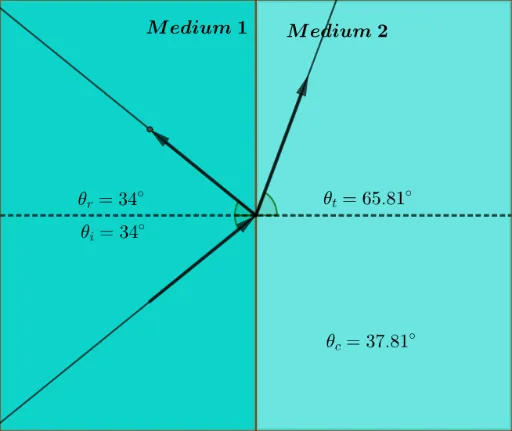
This example visually demonstrates Snell's Law through dynamic geometry, illustrating the relationship between the angle of incidence and the angle of refraction when light passes from one medium to another. Key mathematical concepts include angle measurement, vector operations, refractive index calculation, and geometric construction. GeoGebra commands and objects like segments, polygons, rays, angles, vectors, and textfields are used to construct light paths, label angles, and display refractive indices. Suitable for high school physics and mathematics education to help students intuitively understand refraction phenomena and the application of the law.
GeoGebra Commands & Parameters
Segment(B, C) → fSegment(D, E) → gPolygon(A, F, G, H, I) → polígono1, a, f_1, g_1, h, iPolygon(A, F, J, K, I) → polígono2, a_1, f_2, j, k, i_1Ray(A, L) → lRay(A, M) → mAngle(M, A, B) → αAngle(B, A, L) → βRay(A, N) → nAngle(C, A, N) → γVector(L, A) → uVector(A, M) → vVector(A, N) → wTextfield(n_1) → CasillaDeEntrada1Textfield(n_2) → CasillaDeEntrada2Textfield(θ_i) → CasillaDeEntrada3
AI Drawing Prompt Reference
Draw a diagram demonstrating Snell's Law. Include an incident ray, a refracted ray, an angle of incidence, and an angle of refraction. Show these angles using adjustable text boxes. Add two points representing different media. Ensure the diagram is clear and labeled to help understand refraction when light passes from one medium to another.
The prompt above was compiled from the original drawing commands and is for reference only.