
Skew Lines in 3D Space
Loading the math board and drawing, please wait…
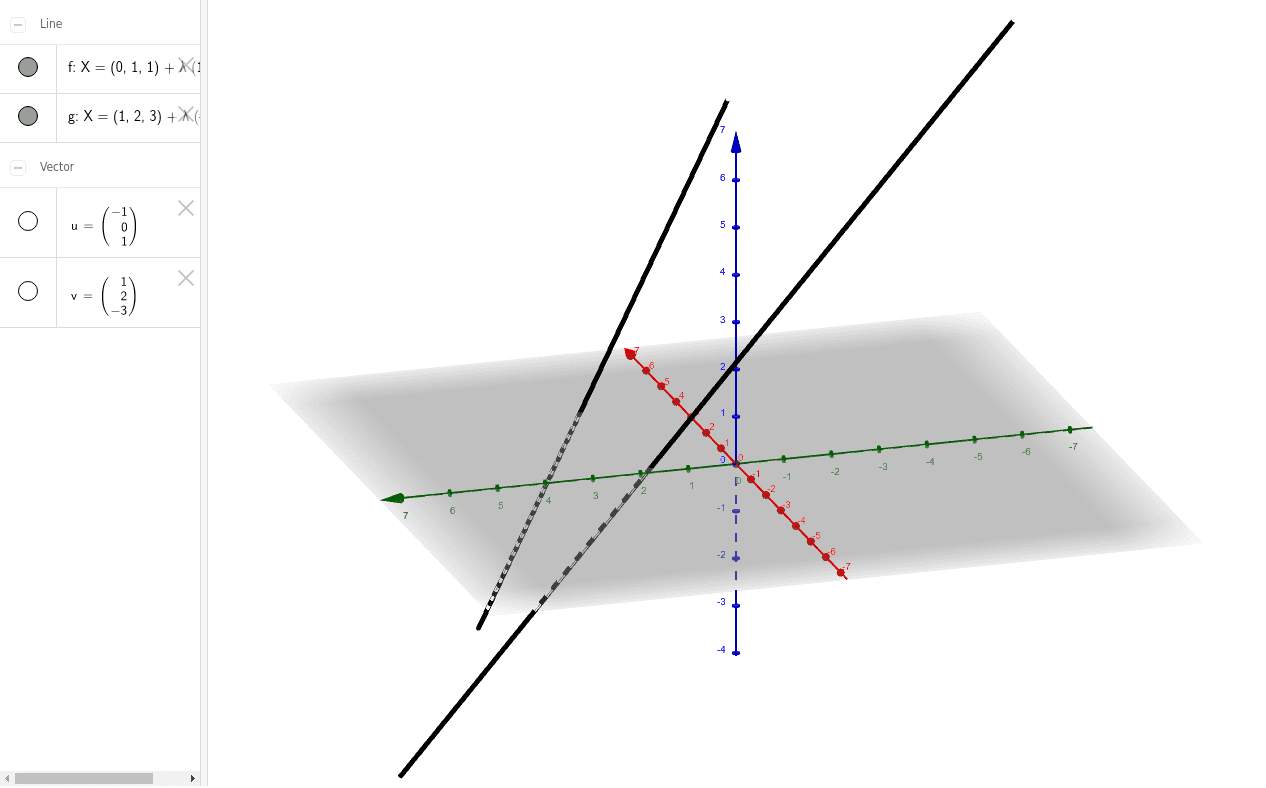
① This example visually demonstrates two skew lines (lines that are neither parallel nor intersecting) in three-dimensional space, helping learners understand the fundamental classification of line relationships in solid geometry. ② Core mathematical concepts include the definition of skew lines, direction vectors in space, parametric equations of lines, and determining relative positions of lines in 3D. ③ Construction highlights: using GeoGebra's Vector command to create direction vectors v and u, and the Line command to generate lines f and g; by adjusting vector directions and positions, the two lines are shown in a typical skew configuration within a 3D coordinate system, with auxiliary elements like a parabola, quadrilateral, and circle enriching the spatial scene. ④ Suitable for high school solid geometry or college spatial analytic geometry courses, serving as an interactive tool for demonstrating skew lines and enabling students to explore spatial line relationships independently.
GeoGebra Commands & Parameters
Vector((1, 2, -3)) → vLine((0, 1, 1), v) → fVector((-1, 0, 1)) → uLine((1, 2, 3), u) → g
AI Drawing Prompt Reference
In a 3D coordinate system, draw two skew lines: one passing through point (0,1,1) with direction vector (1,2,-3), and another through point (1,2,3) with direction vector (-1,0,1). These lines are neither parallel nor intersecting, showing a typical skew configuration. Indicate each direction vector with an arrow, and add auxiliary elements like a parabola, a quadrilateral, and a circle to enrich the spatial scene, aiding understanding of line relationships in space.
The prompt above was compiled from the original drawing commands and is for reference only.