
Sketch Second Derivatives - 1
Loading the math board and drawing, please wait…
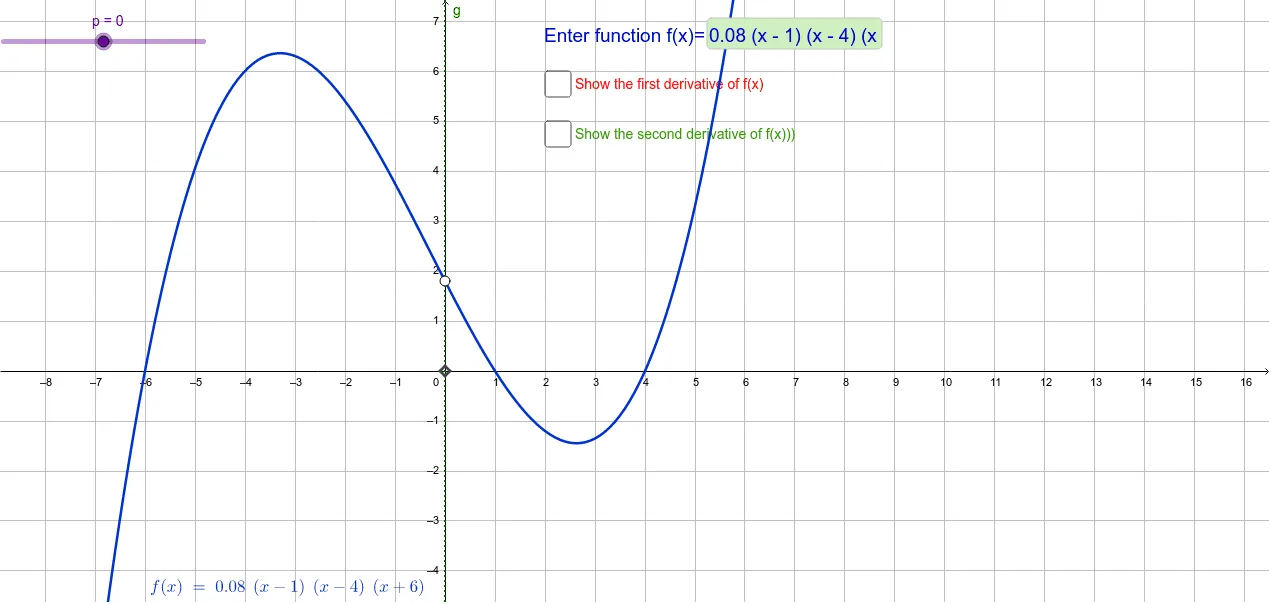
This GeoGebra example demonstrates how to sketch the first and second derivatives of a given function f interactively. The core mathematical concept is the geometric meaning of derivatives: the first derivative represents the slope of the tangent line, while the second derivative indicates the rate of change of the slope, revealing concavity and inflection points. The construction uses a Textfield for user input of the function, the Derivative command to automatically generate f' and f'', and the Intersect command to locate key points such as extrema or inflection points. Points A, B, P, C are used to mark special locations, and sliders a and b may adjust the viewing interval. This example is suitable for high school or introductory college calculus students to build intuition about higher-order derivatives and their graphical interpretation, and it can serve as an interactive classroom exercise.
GeoGebra Commands & Parameters
Textfield(f) → InputBox1Derivative(f) → f'Intersect(f', g, (0, -1.95)) → AIntersect(f, g, (0, 1.7999999999999998)) → BDerivative(f') → f''Intersect(f'', g, (0, 0.1499999999999999)) → C
AI Drawing Prompt Reference
Draw a graph showing a function and its first and second derivatives. Start with an input box to define the original function, then automatically generate its derivative and second derivative curves. Mark the intersections of the first derivative with a horizontal line as extrema, the intersections of the original function with a horizontal line as zeros, and the intersections of the second derivative with a horizontal line as inflection points. Use sliders to adjust the viewing interval for better observation. The final image includes three curves and several key points, illustrating the relationship between derivatives and concavity.
The prompt above was compiled from the original drawing commands and is for reference only.