
Sitting on the Fence: Geometric Solving of Absolute-Value Inequalities
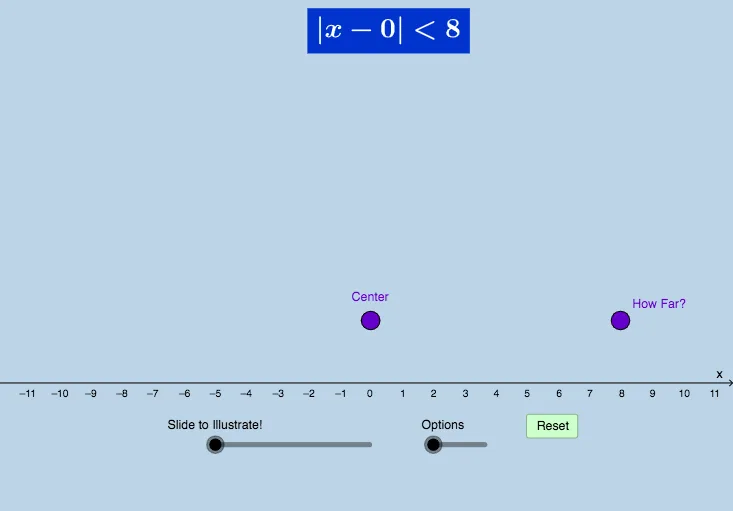
Loading the math board and drawing, please wait…
This example demonstrates—via interactive geometry—the solution of absolute-value inequalities by visualizing a distance-based condition and identifying where it holds. It centers on key ideas such as rewriting absolute-value inequalities as equivalent statements about distances to fixed points, understanding boundary cases where the inequality switches, and using geometric loci to represent the solution set. In the GeoGebra construction, commands like Ray, Point, Mirror, and Vector help build the symmetric/reflective setup; Distance and Segment measure the relevant distances (e.g., |x−a| and distances to endpoints); Circle provides the boundary defined by a constant distance; Intersect determines critical intersection points; Polygon highlights the final admissible region. Additional commands such as Translate, Dilate, and Text are used to position transformed elements and label thresholds clearly. Suitable for middle/high school through early university learners, especially for teaching and learning the graphical/geometric method for absolute-value inequalities.
GeoGebra Commands & Parameters
Ray(A, B) → fRay(A, C) → gPoint(f) → EMirror(E, A) → E'Vector(A, E) → uVector(A, E') → vDistance(A, E) → distanceAEDistance(A, E') → distanceAE'Ray(F, H) → hRay(D, G) → lSegment(D, F) → mCircle(A, 1) → cCircle(E', 1) → dCircle(E, 1) → eCircle(D, 4) → c_1Circle(F, 4) → d_1Intersect(c_1, t, 1) → LIntersect(d_1, t, 1) → MSegment(D, L) → f_1Segment(F, M) → g_1Polygon(O, N, 4) → poly1, h_1, i_1, j_1, k_1, R, SPolygon(Q, P, 4) → poly2, l_1, m_1, n_1, p_1, T, UDistance(S, R) → distanceSRDistance(U, T) → distanceUTDilate(A, If[0 < b ≤ 1, 1 - b, 0], E) → A'Segment(A, A') → q_1Dilate(A, If[0 < b ≤ 1, 1 - b, 0], E') → A'_1Segment(A, A'_1) → r_1Dilate(F, If[1 < b ≤ 2, 2 - b, 0], M) → F'Dilate(D, If[1 < b ≤ 2, 2 - b, 0], L) → D'Segment(F, F') → pSegment(D, D') → qTranslate(poly1, (-1.5, 0)) → poly1'Translate(poly2, (1.5, 0)) → poly2'Distance(U, T) → e_1Distance(S, R) → o_1
AI Drawing Prompt Reference
Draw a horizontal ray with a fixed endpoint and a movable point on it. Construct the mirror image of the movable point about the endpoint. Using these three points as centers, draw circles of radius 1 and 4, creating two families of concentric circles. Find intersection points between the rays and circles to define critical positions, then connect these points to form two quadrilateral regions. Based on a variable parameter, dynamically adjust segments between the movable point and its mirror, and translate the quadrilaterals horizontally to show how the solution set changes. Finally, label the distances between key points to illustrate the geometric condition of the absolute-value inequality.
The prompt above was compiled from the original drawing commands and is for reference only.