
Sine Rule - Ambiguous Case Worksheet
Loading the math board and drawing, please wait…
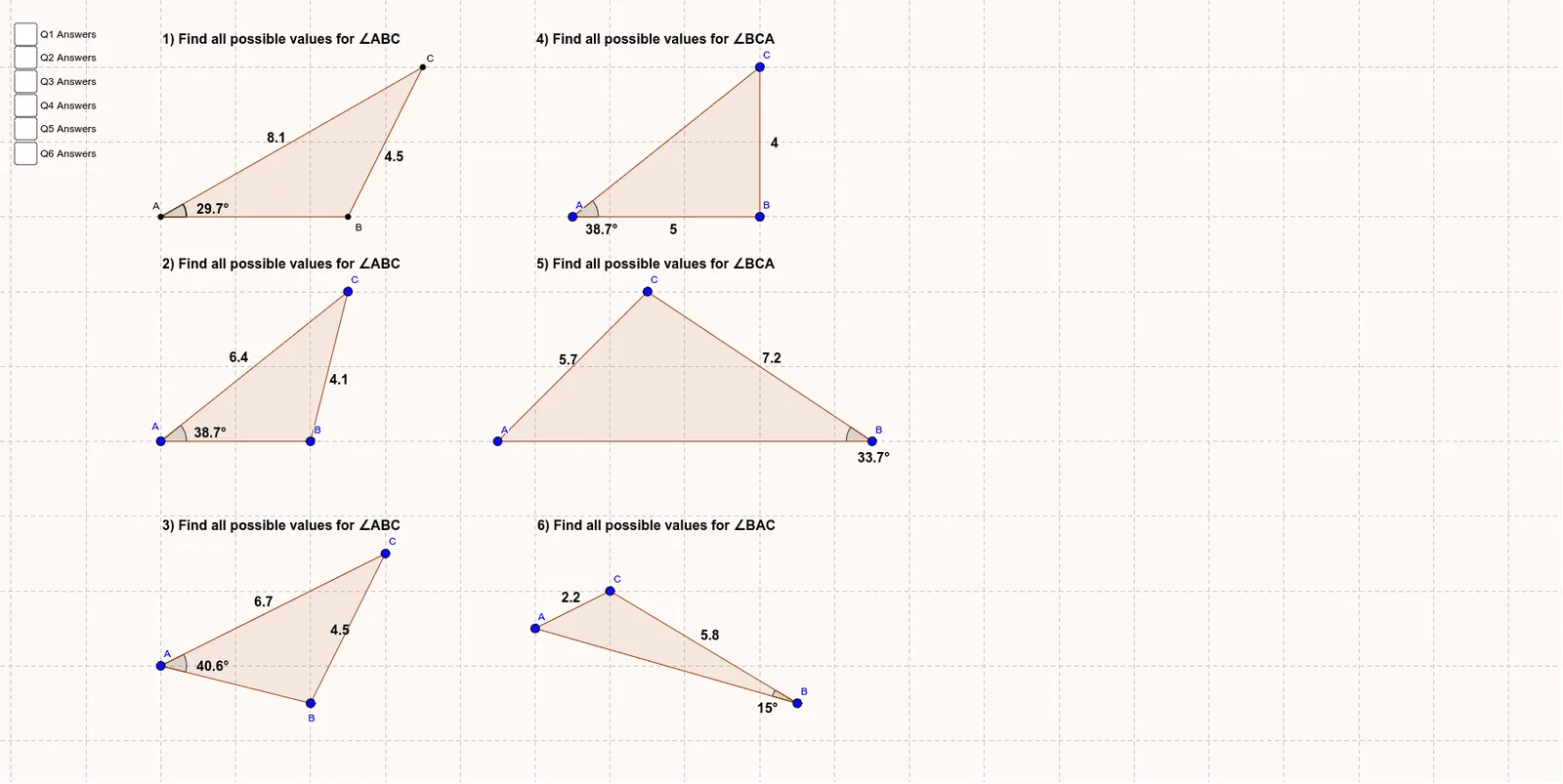
This example demonstrates the ambiguous case of the sine rule in triangle construction, where given two angles and one side or two sides and one angle might lead to two different triangles. It involves core concepts like the sine rule, triangle solving, and geometric construction. GeoGebra commands used include Polygon, Circle, Line, Intersect, Segment, and Angle. Suitable for high school mathematics teaching or student exploration of triangle solving complexity.
GeoGebra Commands & Parameters
Polygon(A, B, C) → poly1, c, a, bPolygon(D, E, F) → poly2, f, d, ePolygon(G, H, I) → poly3, i, g, hPolygon(K, L, M) → poly4, m, k, lPolygon(N, O, P) → poly5, p, n, oPolygon(Q, R, S) → poly6, s, q, rCircle(B, C) → tLine(A, C) → f_1Intersect(t, f_1, 2) → TSegment(B, T) → g_1Circle(E, F) → c_1Line(D, F) → h_1Intersect(c_1, h_1, 2) → USegment(D, U) → i_1Segment(U, E) → j_1Circle(R, S) → d_1Line(Q, S) → k_1Intersect(d_1, k_1, 2) → VSegment(V, R) → l_1Segment(V, S) → m_1Circle(O, N) → e_1Intersect(e_1, o, 2) → WSegment(O, W) → n_1Circle(L, K) → p_1Intersect(p_1, h_1, 2) → ZSegment(L, Z) → q_1Circle(I, H) → r_1Intersect(r_1, i, 2) → JSegment(I, J) → jSegment(C, T) → s_1Angle(B, C, A) → αAngle(B, T, A) → βAngle(C, A, B) → γAngle(E, U, D) → δAngle(E, F, D) → εAngle(F, D, E) → ζAngle(R, V, Q) → ηAngle(R, S, Q) → θAngle(S, Q, R) → ιAngle(I, G, H) → κAngle(G, J, I) → λAngle(G, H, I) → μAngle(L, M, K) → νAngle(M, Z, L) → ξAngle(M, K, L) → οAngle(O, P, N) → ρAngle(P, W, O) → σAngle(P, N, O) → τ
AI Drawing Prompt Reference
Draw two triangles, one constructed by given two sides and an angle, and the other by given two angles and a side, to demonstrate the ambiguous case of the sine rule. Start by drawing the sides and vertices of the triangles, then use circles and lines to construct possible intersection points, connecting these points to form two different triangles. Finally, label the interior angles of each triangle to show the angle relationships.
The prompt above was compiled from the original drawing commands and is for reference only.