
Sine and Cosine of Complementary Angles
Loading the math board and drawing, please wait…
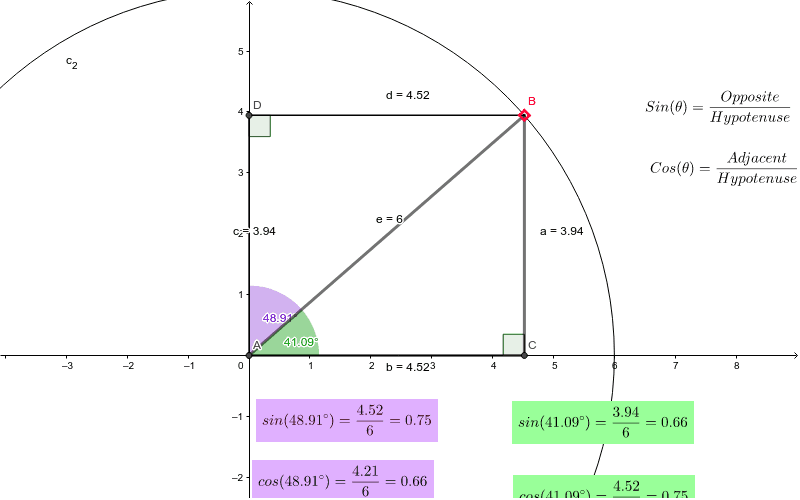
This example demonstrates the relationship between the sine and cosine of complementary angles. Key mathematical concepts include trigonometric functions sine and cosine. Using commands such as Intersect, Circle, Point, OrthogonalLine, Polygon, Angle, Distance, the construction involves creating circles, points, lines, and polygons. Suitable for students at the junior high school level and above to learn the basic properties of trigonometric functions.
GeoGebra Commands & Parameters
Intersect(xAxis, yAxis) → ACircle(A, B_1) → c_2Point(c_2) → BOrthogonalLine(B, xAxis) → a_3OrthogonalLine(B, yAxis) → b_1Intersect(b_1, yAxis) → DIntersect(a_3, xAxis) → CPolygon(A, C, B) → poly2, b, a, ePolygon(D, A, B) → poly1, c, d_1, dAngle(poly1) → d_3, d_2, γAngle(poly2) → δ, ε, ζDistance(A, B) → AC
AI Drawing Prompt Reference
Draw a coordinate system with the origin as the center of a circle, then take a point B on the circle and draw perpendicular lines from B to the x-axis and y-axis, which intersect the axes at points D and C, respectively. Next, draw a triangle with points A, C, and B, and another triangle with points D, A, and B. Finally, measure the angles and side lengths of the two triangles.
The prompt above was compiled from the original drawing commands and is for reference only.