
Similar Triangles Scale Factor
Loading the math board and drawing, please wait…
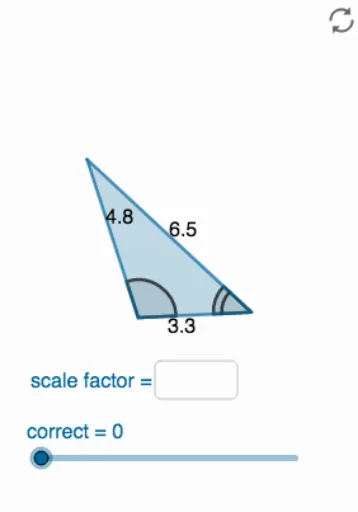
This example demonstrates the calculation and visualization of scale factors in similar triangles. It involves core math concepts like the properties and criteria of similar triangles, proportional relationships, and angle measurements. Construction highlights include commands like Polygon, RandomPointIn, Midpoint, Random, Mirror, PointIn, Min, Max, Angle, Textfield, Shuffle, Element for generating and transforming random triangles. Suitable for high school mathematics teaching to understand applications and proportion calculations in similar triangles.
GeoGebra Commands & Parameters
Polygon(A, B, C, D) → q1, a, b, c, dPolygon(E, F, G, H) → q2, e, f, g, hPolygon(I, J, K, L) → q3, i, j, k, lRandomPointIn(q1) → PRandomPointIn(q2) → QRandomPointIn(q3) → RPolygon(P, Q, R) → t1, r, p, qMidpoint(P, Q) → OMidpoint(Q, R) → SMidpoint(P, R) → TRandom(30, 270) → angleMirror(Rotate[Polygon[Dilate[P, scalefactor], Dilate[Q, scalefactor], Dilate[R, scalefactor]], angle°], x = 0) → t2PointIn(t2) → UPointIn(t2) → VPointIn(t2) → WMin({x(U), x(W), x(V)}) → xminMax({x(U), x(V), x(W)}) → xmaxMin({y(U), y(V), y(W)}) → yminMax({y(U), y(W), y(V)}) → ymaxMax({x(P), x(Q), x(R)}) → x1maxMin({x(P), x(Q), x(R)}) → x1minMax({y(P), y(Q), y(R)}) → y1maxMin({y(P), y(Q), y(R)}) → y1minMidpoint(U, W) → ZMidpoint(W, V) → A_1Midpoint(U, V) → B_1Angle(R, P, Q) → αAngle(V, U, W) → βAngle(Q, R, P) → γAngle(U, W, V) → δTextfield(empty1) → InputBox1Shuffle(list1) → list2Element(list2, 1) → s1Element(list2, 2) → s2Element(list2, 3) → s3
AI Drawing Prompt Reference
Draw two random triangles, then take three random points from the first triangle to form a third triangle. Scale and rotate the third triangle by a certain angle to get a fourth triangle. Find the range of x and y coordinates of the three vertices of the fourth triangle, and generate three new points within this range. Connect these points to form a new triangle, and calculate the sizes of the corresponding angles of all triangles. Finally, draw all four triangles together and label the sizes of the corresponding angles.
The prompt above was compiled from the original drawing commands and is for reference only.