
Similar Triangles Activity
Loading the math board and drawing, please wait…
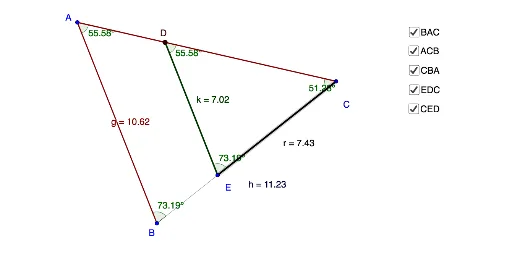
① This interactive GeoGebra activity demonstrates the concept of similar triangles, showing how corresponding angles are equal and corresponding sides are proportional. ② Core mathematical concepts include similarity criteria (AA, SAS, SSS), scale factor, corresponding angles and sides, and the triangle angle sum theorem. ③ Construction details: Using GeoGebra commands such as Line, Segment, Point, Intersect, and Angle, the activity constructs triangle ABC with auxiliary lines, points D and E, and segments l, m, n to form similar triangles. Angles α, β, γ, δ, ε and angles BAC, ACB are labeled to highlight equal corresponding angles, while segments a, b, c and auxiliary lines p, q, r support the construction. ④ Suitable for middle school geometry lessons or self-study, this activity helps students explore similarity conditions and visualize how triangles scale while preserving shape.
GeoGebra Commands & Parameters
Line(A, B) → fSegment(A, B) → gSegment(B, C) → hSegment(C, A) → iPoint(i) → DLine(D, g) → jIntersect(j, h) → ESegment(D, E) → kAngle(B, A, C) → αAngle(E, D, C) → βAngle(A, C, B) → γAngle(C, B, A) → δAngle(C, E, D) → εSegment(E, C) → lSegment(E, C) → mSegment(E, C) → nSegment(E, C) → pSegment(E, C) → qSegment(E, C) → r
AI Drawing Prompt Reference
Draw a large triangle with a base side. Pick a point on one of the other sides, and draw a line through that point parallel to the base, intersecting the third side, forming a smaller triangle inside. Label the three angles of the large triangle, and the two angles of the small triangle adjacent to the base, plus the corresponding angles formed by the parallel line. Use distinct colors or line styles to differentiate the large triangle, the small triangle, and the auxiliary parallel line, emphasizing equal corresponding angles.
The prompt above was compiled from the original drawing commands and is for reference only.