
Similar Right Triangles Demo by Philip Taylor
Loading the math board and drawing, please wait…
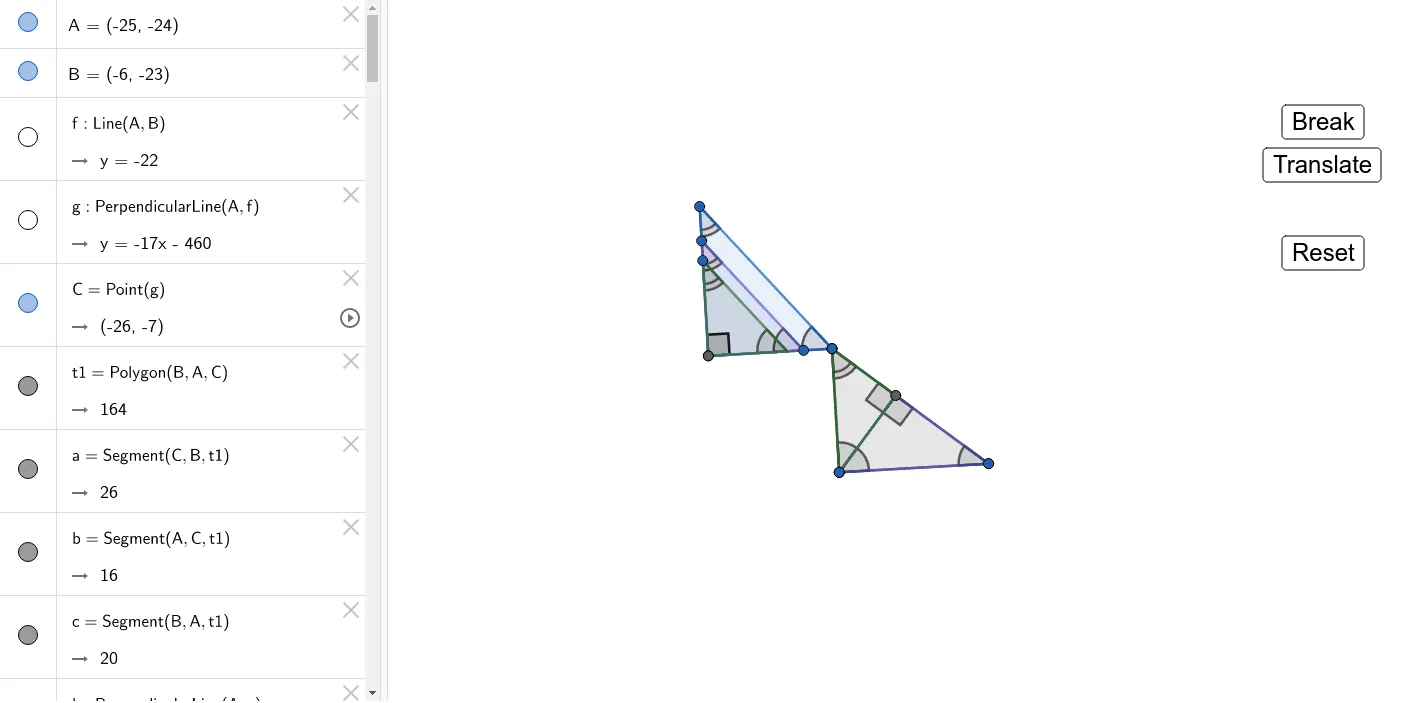
This example demonstrates the construction and properties of similar right triangles. It involves core math concepts like similarity criteria, right triangle characteristics, angle-side relationships, area calculations, and percentages. Construction uses commands such as Line, OrthogonalLine, Point, Polygon, Intersect, Segment, Angle, Rotate, Mirror, Vector, and Translate. Suitable for high school mathematics teaching on similarity and geometric transformations.
GeoGebra Commands & Parameters
Line(A, B) → fOrthogonalLine(A, f) → gPoint(g) → CPolygon(B, A, C) → t1, c, b, aOrthogonalLine(A, a) → hIntersect(h, a) → DSegment(A, D) → iPolygon(A, D, B) → t2, b_1, a_1, dPolygon(D, A, C) → t3, c_1, d_1, a_2Angle(C, D, A) → αAngle(D, B, A) → βAngle(A, D, B) → γAngle(D, A, C) → δAngle(A, C, D) → εAngle(B, A, D) → ζRotate(D, ((-t) * (π - β)), A) → D'Rotate(A, ((-t) * (π - β)), A) → A'Rotate(C, ((-t) * (π - β)), A) → C'Polygon(D', A', C') → t3', c', d', a'Rotate(D, ((-t) * (π - β)), A) → D'_1Rotate(A, ((-t) * (π - β)), A) → A'_1Rotate(C, ((-t) * (π - β)), A) → C'_1Polygon(D'_1, A'_1, C'_1) → t3'_1, c'_1, d'_1, a'_1Rotate(A, (t * (π / 2 + β)), B) → A'_2Rotate(D, (t * (π / 2 + β)), B) → D'_2Rotate(B, (t * (π / 2 + β)), B) → B'Polygon(A'_2, D'_2, B') → t2', b', a'_2, d'_2Line(C, c) → jMirror(B, j) → B'_1Mirror(A, j) → A'_3Mirror(C, j) → C'_2Rotate(B'_1, (t * π / 2), C) → ERotate(A'_3, (t * π / 2), C) → FRotate(C'_2, (t * π / 2), C) → GPolygon(E, F, G) → t1'', g_1, e, f_1Vector(D'_2 - F) → uVector(D'_1 - F) → vTranslate(A'_2, Vector[((-k) * u)]) → HTranslate(D'_2, Vector[((-k) * u)]) → ITranslate(B', Vector[((-k) * u)]) → B''Polygon(H, I, B'') → t2'', b'', h_1, i_1Translate(D', Vector[((-k) * v)]) → D''Translate(A', Vector[((-k) * v)]) → A''Translate(C', Vector[((-k) * v)]) → C''Polygon(D'', A'', C'') → t3'', c'', d'', a''Angle(C'', D'', A'') → θAngle(G, F, E) → ιAngle(F, E, G) → κAngle(D'', A'', C'') → λAngle(I, B'', H) → μAngle(B'', H, I) → νAngle(A'', C'', D'') → ξAngle(E, G, F) → ο