
Similar Right Triangles 10 – Exploring Similarity and Dilation
Loading the math board and drawing, please wait…
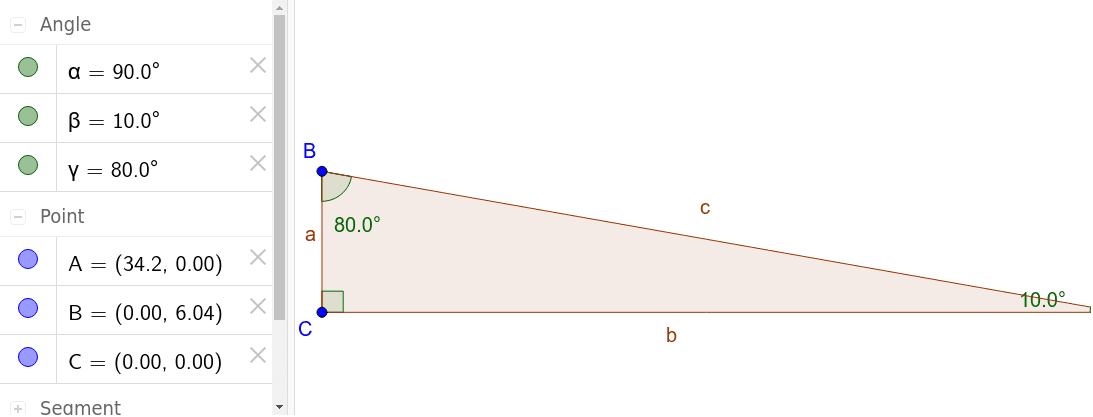
This GeoGebra example constructs a family of similar right triangles and investigates the relationships among their corresponding sides and angles. Key mathematical ideas include the properties of similar triangles, trigonometric ratios, dilation (homothety) transformations, and the use of arithmetic mean in area calculations. The construction employs GeoGebra commands Point, Intersect, Polygon, and Angle to define vertices A, B, C and polygon poly1, uses parameters a, b, c for scaling, sets angles α, β, γ, and leverages Intersection to locate critical points. The example not only demonstrates how similar triangles preserve angles while scaling side lengths proportionally, but also shows how interactive sliders can visualize the effect of dilation on the shape and how arithmetic mean can compute the average area of a series of similar triangles. An interactive exploration feature allows students to adjust parameters dynamically, observe how similarity influences geometric properties, and deepen their understanding of similarity transformations, trigonometric relationships, and averaging concepts. Designed for high‑school geometry and trigonometry classes as well as university‑level introductory geometry or modeling courses, it serves as an effective tool for teacher demonstrations, classroom investigations, or student‑led explorations.
GeoGebra Commands & Parameters
Point(yAxis) → BPoint(xAxis) → AIntersect(xAxis, yAxis) → CPolygon(B, C, A) → poly1, a, b, cAngle(A, C, B) → αAngle(B, A, C) → βAngle(C, B, A) → γ