
Side-Side-Side Congruence
Loading the math board and drawing, please wait…
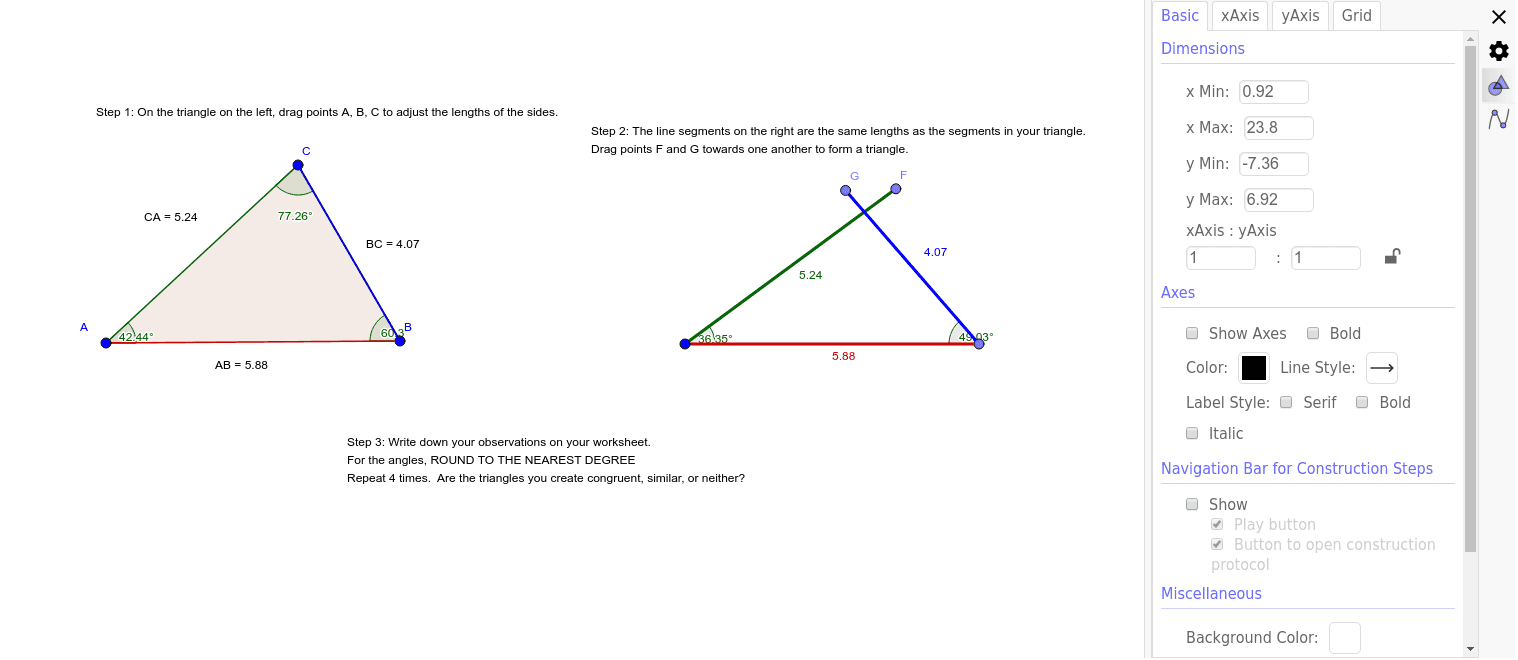
This example demonstrates the Side-Side-Side (SSS) congruence theorem, which states that if two triangles have all three sides equal, then the triangles are congruent. Key concepts include triangle congruence, distance measurement, and angle measurement. Using GeoGebra commands such as Polygon, Distance, and Angle, two congruent triangles can be constructed. Suitable for middle school and above students to learn about triangle congruence through geometric construction.
GeoGebra Commands & Parameters
Polygon(A, B, C) → poly1, c, a, bDistance(A, B) → distanceABDistance(B, C) → distanceBCDistance(C, A) → distanceCAAngle(B, A, C) → αAngle(A, C, B) → βAngle(C, B, A) → γPoint(Circle[D, c]) → ESegment(D, E) → dPoint(Circle[D, b]) → FSegment(D, F) → ePoint(Circle[E, a]) → GSegment(E, G) → fAngle(E, D, F) → δAngle(G, E, D) → ε
AI Drawing Prompt Reference
Draw two congruent triangles to demonstrate the SSS congruence theorem, showing that triangles with all three sides equal are congruent. Start by drawing the three sides of the first triangle and measure the lengths of each side and the size of each angle. Then, use the length of the first side as a reference, draw a circle with the second side's length, and find the intersection points with a circle drawn using the third side's length. Connect these points to form the second triangle, ensuring both triangles are congruent, and label the key distances and angles.
The prompt above was compiled from the original drawing commands and is for reference only.