
Side, Perimeter, and Area Ratios of Similar Figures
Loading the math board and drawing, please wait…
In collections
Measurement
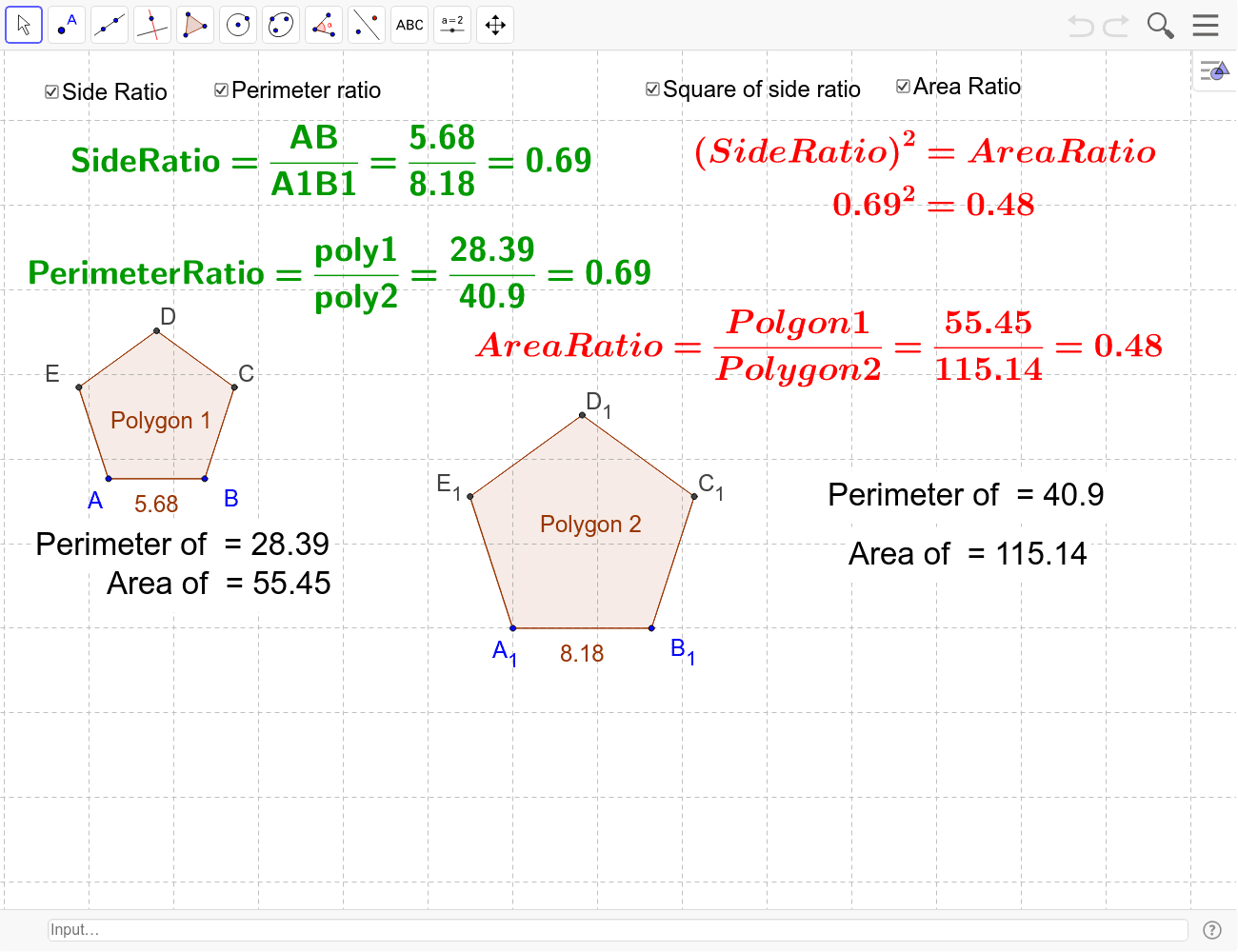
①This example uses two similar polygons to visually demonstrate the proportional relationships among corresponding sides, perimeters, and areas. ②Core mathematical concepts include similarity ratio (linear scale factor) and its squared effect on area: if the similarity ratio is k, then the perimeter ratio is k and the area ratio is k². ③Construction highlights: using GeoGebra commands such as Polygon to create two similar polygons (e.g., A, B and A_1, B_1), Perimeter to compute perimeters, and text objects (Textpoly1, Textpoly11) to display side lengths, perimeters, and areas, along with ratio texts (arearatio) to show the area ratio. ④Suitable for upper middle school or high school students, this resource supports learning about similarity properties in geometry, and can serve as an interactive demonstration for teachers.
GeoGebra Commands & Parameters
Polygon(A, B, 5) → areapoly1, a, b, c, d, e, C, D, EPolygon(A_1, B_1, 5) → areapoly1_1, a_1, b_1, c_1, d_1, e_1, C_1, D_1, E_1Perimeter(areapoly1) → perimeterpoly1Perimeter(areapoly1_1) → perimeterpoly11
AI Drawing Prompt Reference
Draw two similar pentagons to demonstrate the proportional relationships among corresponding sides, perimeters, and areas. Use a slider to adjust the similarity ratio and observe how the perimeter and area change. The perimeter ratio equals the similarity ratio, while the area ratio equals the square of the similarity ratio. Label the side lengths, perimeters, and areas of each pentagon, and display the area ratio.
The prompt above was compiled from the original drawing commands and is for reference only.