
Shree Yanthra Geometric Construction
Loading the math board and drawing, please wait…
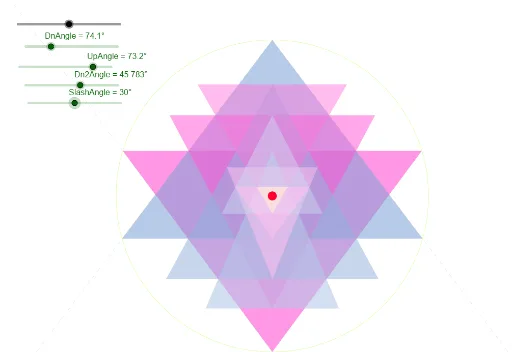
This example demonstrates the geometric construction of Shree Yanthra, integrating polygons, circumcircles, and trigonometric functions. Key math concepts include polygon construction, circumcircle, cosine theorem, rotation, and reflection. GeoGebra commands used are points, circles, orthogonal lines, intersections, rotations, angles, rays, reflections, segments, and polygons. Suitable for high school and above learners to explore geometric constructions and transformation principles.
GeoGebra Commands & Parameters
Point(xAxis) → ACircle(A, Radius) → cOrthogonalLine(A, xAxis) → fIntersect(c, xAxis) → B, CIntersect(c, f) → D, ERotate(A, DnAngle / 2, E) → A'Angle(A, E, A') → αRay(E, A') → gMirror(E, f) → E'Mirror(A', f) → A''Ray(E', A'') → g'Rotate(A, UpAngle / 2, D) → A'_1Angle(A, D, A'_1) → βRay(D, A'_1) → hMirror(D, f) → D'Mirror(A'_1, f) → FRay(D', F) → h'Intersect(c, h) → G, HIntersect(c, h') → I, JIntersect(c, g') → K, LIntersect(c, g) → M, NSegment(L, N) → iSegment(N, E) → jSegment(E, L) → kSegment(D, J) → lSegment(J, H) → mSegment(H, D) → nIntersect(m, f) → OCircle(B, A) → dCircle(C, A) → eIntersect(c, d) → P, Q, ,Intersect(e, c) → R, S, ,Rotate(D, Dn2Angle / 2, O) → D'_1Angle(D, O, D'_1) → γRay(O, D'_1) → pMirror(O, f) → O'Mirror(D'_1, f) → TRay(O', T) → p'Intersect(m, g') → UIntersect(m, g) → VIntersect(h', l) → WIntersect(p, h') → ZIntersect(p', i) → A_1Intersect(p, i) → B_1Line(V, B_1) → qLine(U, A_1) → rIntersect(q, r) → C_1OrthogonalLine(C_1, f) → sIntersect(s, p') → D_1Intersect(p, s) → E_1Segment(D_1, E_1) → tSegment(E_1, O) → aSegment(O, D_1) → bRotate(C, SlashAngle, A) → C'Angle(C, A, C') → δRay(A, C') → f_1Intersect(p, a) → F_1Intersect(f_1, p) → G_1Circle(A, G_1) → c_1Intersect(c_1, f) → H_1, I_1Ray(H_1, G_1) → g_1Mirror(H_1, f) → J_1Mirror(G_1, f) → K_1Ray(J_1, K_1) → h_1Intersect(i, h) → L_1Intersect(h', l) → M_1Intersect(h', l) → N_1Intersect(h', l) → O_1Intersect(i, h') → P_1Intersect(m, h_1) → Q_1Intersect(m, g_1) → R_1Intersect(g', k) → S_1Intersect(h_1, g') → T_1Intersect(g_1, g) → U_1Line(T_1, U_1) → i_1Intersect(r, i_1) → V_1Intersect(q, i_1) → W_1Segment(C_1, W_1) → j_1Segment(W_1, V_1) → k_1Segment(V_1, C_1) → l_1Line(L_1, Q_1) → m_1Line(R_1, P_1) → n_1Intersect(m_1, n_1) → Z_1Intersect(m_1, r) → A_2Intersect(n_1, q) → B_2Intersect(h, n) → C_2Intersect(p', b) → D_2Intersect(h, n) → E_2Intersect(h, n) → F_2Intersect(h, n) → G_2Intersect(h, n) → H_2Intersect(p', b) → I_2Intersect(p', b) → J_2Intersect(h, n) → K_2Intersect(h, n) → L_2Intersect(p', h) → M_2Line(M_2, Z) → p_1Intersect(m_1, p_1) → N_2Intersect(n_1, p_1) → O_2Line(Z_1, xAxis) → q_1Intersect(h_1, q_1) → P_2Intersect(g_1, q_1) → Q_2Segment(H_1, Q_2) → r_1Segment(Q_2, P_2) → s_1Segment(P_2, H_1) → t_1Segment(Z_1, N_2) → a_1Segment(N_2, O_2) → b_1Segment(O_2, Z_1) → d_1Intersect(g', k) → R_2Intersect(h, n) → S_2Intersect(h, g') → T_2Intersect(h', g) → U_2Intersect(g', k) → V_2Intersect(q_1, s_1) → W_2Intersect(q_1, g') → Z_2Intersect(q_1, g) → A_3Intersect(n_1, i_1) → B_3Intersect(m_1, i_1) → C_3Intersect(s, h) → D_3Intersect(s, h') → E_3Intersect(q, p_1) → F_3Intersect(r, p_1) → G_3Intersect(i_1, f) → H_3Intersect(f, i) → I_3Line(H_1, xAxis) → f_5Intersect(f_5, r) → J_3Intersect(q, f_5) → K_3Segment(J_3, K_3) → g_5Segment(K_3, H_3) → h_5Segment(H_3, J_3) → i_5Intersect(f_5, p) → L_3Intersect(f_5, p') → M_3Intersect(p_1, f) → N_3Ray(N_3, M_3) → j_5Ray(N_3, L_3) → k_5Intersect(m_1, j_5) → O_3Intersect(k_5, n_1) → P_3Segment(N_3, P_3) → l_5Segment(P_3, O_3) → m_5Segment(O_3, N_3) → n_5Intersect(i_5, m) → Q_3Intersect(d, h_5) → R_3,Intersect(m, h_5) → S_3Intersect(i_5, h_1) → T_3Intersect(g_1, r_1) → U_3Intersect(h_5, g_1) → V_3Intersect(p, a) → W_3Intersect(m_5, p) → Z_3Intersect(p', b) → A_4Intersect(m_5, p') → B_4Intersect(i_5, n_5) → C_4Intersect(h_5, l_5) → D_4Intersect(i, n_5) → E_4Intersect(l_5, i) → F_4Line(K_1, G_1) → e_1Intersect(i_5, e_1) → G_4Intersect(e_1, h_5) → H_4Segment(G_4, I_3) → f_2Segment(I_3, H_4) → g_2Segment(H_4, G_4) → h_2Polygon(H, D, J) → t1, j_2, h_3, d_2Polygon(V_1, C_1, W_1) → t2, w_1, v_1, i_2Polygon(P_2, H_1, Q_2) → t3, q_2, p_2, k_2Polygon(O_3, N_3, P_3) → t4, p_3, o_3, n_3Polygon(G_4, I_3, H_4) → t5, h_4, g_4, i_3Polygon(O_3, N_3, P_3) → t6, l_2, m_2, n_2Polygon(E, L, N) → t7, n_4, e_2, l_3Polygon(Z_1, N_2, O_2) → t8, o_2, z_1, r_2Polygon(O, D_1, E_1) → t9, s_2, o, t_2Polygon(H_3, J_3, K_3) → t10, k_3, a_2, j_3Polygon(K_1, H_1, G_1) → t11, b_2, c_2, f_3