
Sherlock's Hat
Loading the math board and drawing, please wait…
In collections
geometriadinamica.es
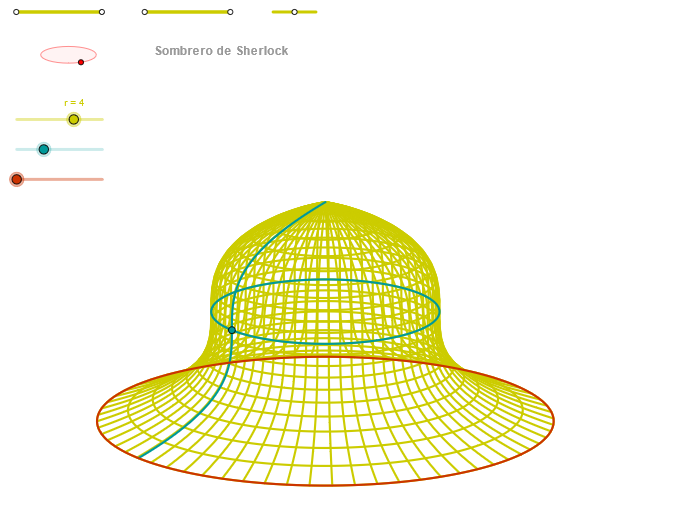
This example demonstrates Sherlock's hat. It involves polynomial functions, logarithmic functions, and normal distribution. Using GeoGebra commands such as Segment, Point, OrthogonalLine, etc., complex geometric shapes can be constructed. Suitable for high school math education and learning.
GeoGebra Commands & Parameters
Segment(Q5, Q6) → p5Point(p5) → P5Segment(Q3, Q4) → p2Point(p2) → P3Segment(P3, Q4) → p4Point(p4) → P4Segment(Q1, Q2) → p1Point(p1) → P1Segment(P1, Q2) → p3Point(p3) → P2OrthogonalLine(C, xAxis) → zz2Circle(C, 0.62) → zz0Intersect(zz0, zz2, 1) → ZZ4Intersect(zz0, zz2, 2) → ZZ3Ellipse(ZZ3, ZZ4, 0.65) → zElipse2Point(zElipse2) → ZIntersect(zElipse2, zz2) → ZZ7, ZZ8Angle(ZZ8, C, Z) → zAngIncOrthogonalLine(C, yAxis) → zz1Intersect(zz0, zz1, 2) → ZZ2Intersect(zz0, zz1, 1) → ZZ1Ellipse(ZZ1, ZZ2, 0.65) → zElipse1Point(zElipse1) → XYIntersect(zElipse1, zz1) → ZZ5, ZZ6Angle(ZZ6, C, XY) → zAngRotSegment(ZZ5, ZZ6) → zz4Segment(ZZ7, ZZ8) → zz3Intersect(zElipse2, zElipse1, 1) → zPunto1Intersect(zElipse2, zElipse1, 4) → zPunto2Segment(zPunto1, zPunto2) → zSeg2CurveCartesian((r / 1.5 * ((((1 - v^(3)) * sin(α)) * sin(zAngRot)) + (((1 - v^(3)) * cos(α)) * cos(zAngRot)))), (r / 1.5 * (((((-(1 - v^(3))) * sin(α)) * cos(zAngRot)) * sin(zAngInc)) + ((((1 - v^(3)) * cos(α)) * sin(zAngRot)) * sin(zAngInc)) + (v * cos(zAngInc)))) + 1, v, v1, v2) → curva2CurveCartesian((r / 1.5 * ((((1 - β^(3)) * sin(u)) * sin(zAngRot)) + (((1 - β^(3)) * cos(u)) * cos(zAngRot)))), (r / 1.5 * (((((-(1 - β^(3))) * sin(u)) * cos(zAngRot)) * sin(zAngInc)) + ((((1 - β^(3)) * cos(u)) * sin(zAngRot)) * sin(zAngInc)) + (β * cos(zAngInc)))) + 1, u, u1, u2) → a1CurveCartesian((r / 1.5 * ((sin(u) * sin(zAngRot)) + (cos(u) * cos(zAngRot)))), (r / 1.5 * ((((-sin(u)) * cos(zAngRot)) * sin(zAngInc)) + ((cos(u) * sin(zAngRot)) * sin(zAngInc)))) + 1, u, u1, u2) → curva1Sequence(CurveCartesian[(r / 1.5 * ((((1 - v^(3)) * sin(u)) * sin(zAngRot)) + (((1 - v^(3)) * cos(u)) * cos(zAngRot)))), (r / 1.5 * (((((-(1 - v^(3))) * sin(u)) * cos(zAngRot)) * sin(zAngInc)) + ((((1 - v^(3)) * cos(u)) * sin(zAngRot)) * sin(zAngInc)) + (v * cos(zAngInc)))) + 1, v, v1, v2], u, u1, u2, paso) → list2Sequence(CurveCartesian[(r / 1.5 * ((((1 - v^(3)) * sin(u)) * sin(zAngRot)) + (((1 - v^(3)) * cos(u)) * cos(zAngRot)))), (r / 1.5 * (((((-(1 - v^(3))) * sin(u)) * cos(zAngRot)) * sin(zAngInc)) + ((((1 - v^(3)) * cos(u)) * sin(zAngRot)) * sin(zAngInc)) + (v * cos(zAngInc)))) + 1, u, u1, u2], v, v1, v2, paso) → list1
AI Drawing Prompt Reference
Draw a Sherlock-style hat. Start with a horizontal baseline, then build the brim outline using segments and points. The crown consists of two intersecting ellipses sharing a vertical centerline, tilted at angles. Fill the interior and surroundings with smooth curves and a grid of curved surfaces to create a 3D effect. The overall shape is symmetric, with interwoven curves forming a complex geometric design.
The prompt above was compiled from the original drawing commands and is for reference only.