
Sequences of Rigid Transformations: Translation, Reflection, and Rotation
Loading the math board and drawing, please wait…
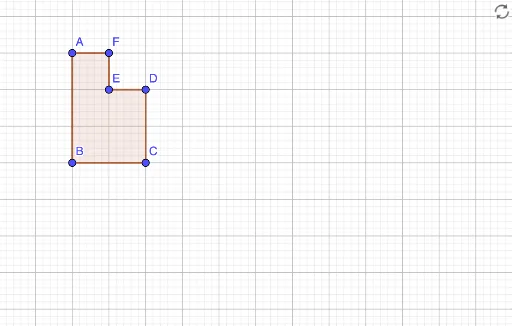
① This example demonstrates how a sequence of rigid transformations (translation, reflection, and rotation) applied to a polygon changes its position and orientation while preserving its shape and size. ② The core mathematical concepts are rigid transformations (isometries) and their composition, including translation, reflection, and rotation, emphasizing congruence and the effect of transformation order. ③ Construction details: Based on the construction summary, the GeoGebra command Polygon is used to create polygons (objects A, B, C, D, E, F and poly1), with edges or vectors (a, b, c, d, e, f) defined, and the transformation sequence is built using these base objects, possibly with sliders or modes to animate each step. ④ This is suitable for middle school to high school students learning geometric transformations, and for teachers to demonstrate the properties of rigid transformations and composite transformations in class.
GeoGebra Commands & Parameters
Polygon(A, B, C, D, E, F) → poly1, a, b, c, d, e, f