
Segment Addition: Points, Segments, and Distance Construction
Loading the math board and drawing, please wait…
In collections
Geometry CK12 CH01 Basics
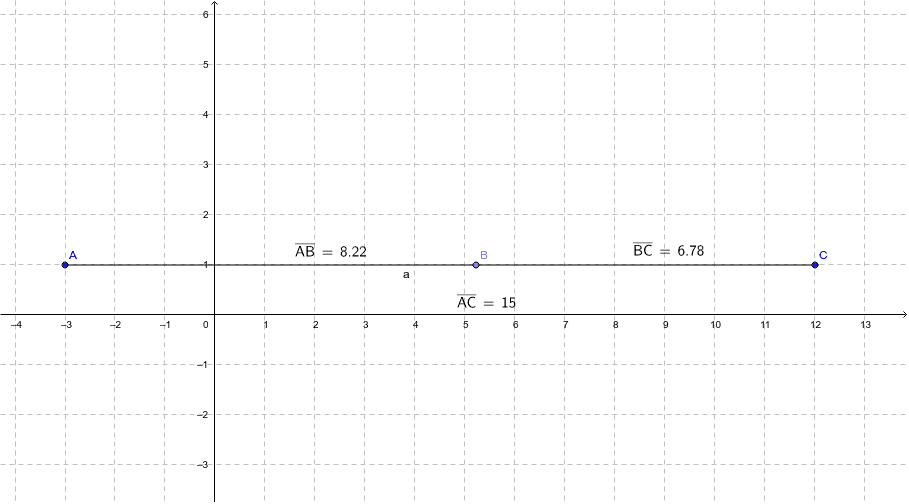
This GeoGebra example demonstrates the segment addition postulate by showing how the lengths of adjacent segments AB and BC sum to the total length AC when points A, B, and C are collinear. The core mathematical concepts involved include points, line segments, distance measurement, the segment addition axiom (AB + BC = AC), and basic Euclidean geometric measurement. The construction uses GeoGebra commands Point to create points A, B, and C; Segment to construct segments AB, BC, and AC; Distance to compute distanceAB, distanceAC, and distanceBC; and text objects TextAB, TextAC, and TextBC to label the computed lengths directly on the drawing. This resource is suitable for middle school geometry (grades 7–9), high school analytic geometry review, and classroom demonstrations, helping students visualize segment length additivity and the relationship between point order and segment measures.
GeoGebra Commands & Parameters
Segment(A, C) → aPoint(a) → BDistance(A, B) → distanceABDistance(A, C) → distanceACDistance(B, C) → distanceBC
AI Drawing Prompt Reference
Create a geometric diagram demonstrating the segment addition postulate. Include three collinear points A, B, and C, with B positioned between A and C. Draw the segments AB, BC, and AC connecting these points. Compute the distances for AB, AC, and BC, and add text labels to display these lengths directly on the diagram. The construction should begin by drawing segment AC, then placing point B along it, followed by measuring the distances and finally adding the length annotations to show that AB plus BC equals AC.
The prompt above was compiled from the original drawing commands and is for reference only.