
Segment Addition on a Line: Constructing a Segment Sum with Circles
Loading the math board and drawing, please wait…
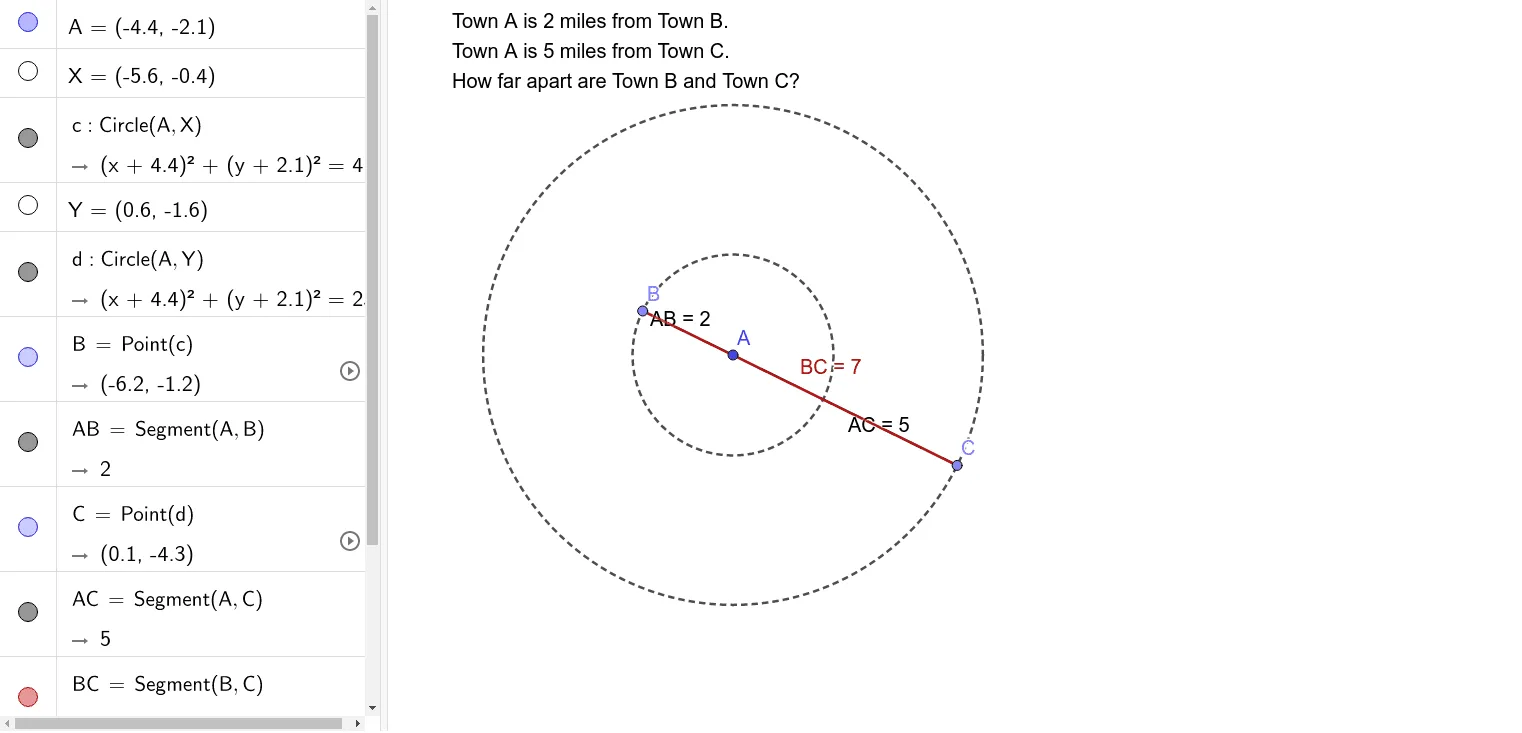
This example demonstrates how to perform segment addition under a collinearity condition using a classical geometric construction. It targets the length-algebra idea that, when points are collinear, a segment sum can be realized by transferring lengths through construction steps. The key concepts include collinear points, segment addition (algebraic relations between lengths), and geometric construction with circles to enforce equal distances. Construction-wise, the provided GeoGebra commands are Circle, Point, and Segment. The construction creates points such as A, X, c, Y, d, and B, and uses segments AB, AC, and BC to represent the relevant length relationships. A circle is used to locate the necessary auxiliary points with the correct distance constraints, and then segments connect the points to visually encode the resulting segment sum. Suitable for middle-to-high school geometry instruction, interactive demonstrations, and learners practicing geometric construction methods.
GeoGebra Commands & Parameters
Circle(A, X) → cCircle(A, Y) → dPoint(c) → BSegment(A, B) → ABPoint(d) → CSegment(A, C) → ACSegment(B, C) → BC
AI Drawing Prompt Reference
Start from a base point, draw two circles centered at it with radii determined by two given points. Choose a point on the first circle as one endpoint and a point on the second circle as the other endpoint. Connect the base point to both chosen points and also connect the two chosen points, forming a triangle that illustrates segment addition under collinearity.
The prompt above was compiled from the original drawing commands and is for reference only.