
Sector to Lateral Area of Cone
Loading the math board and drawing, please wait…
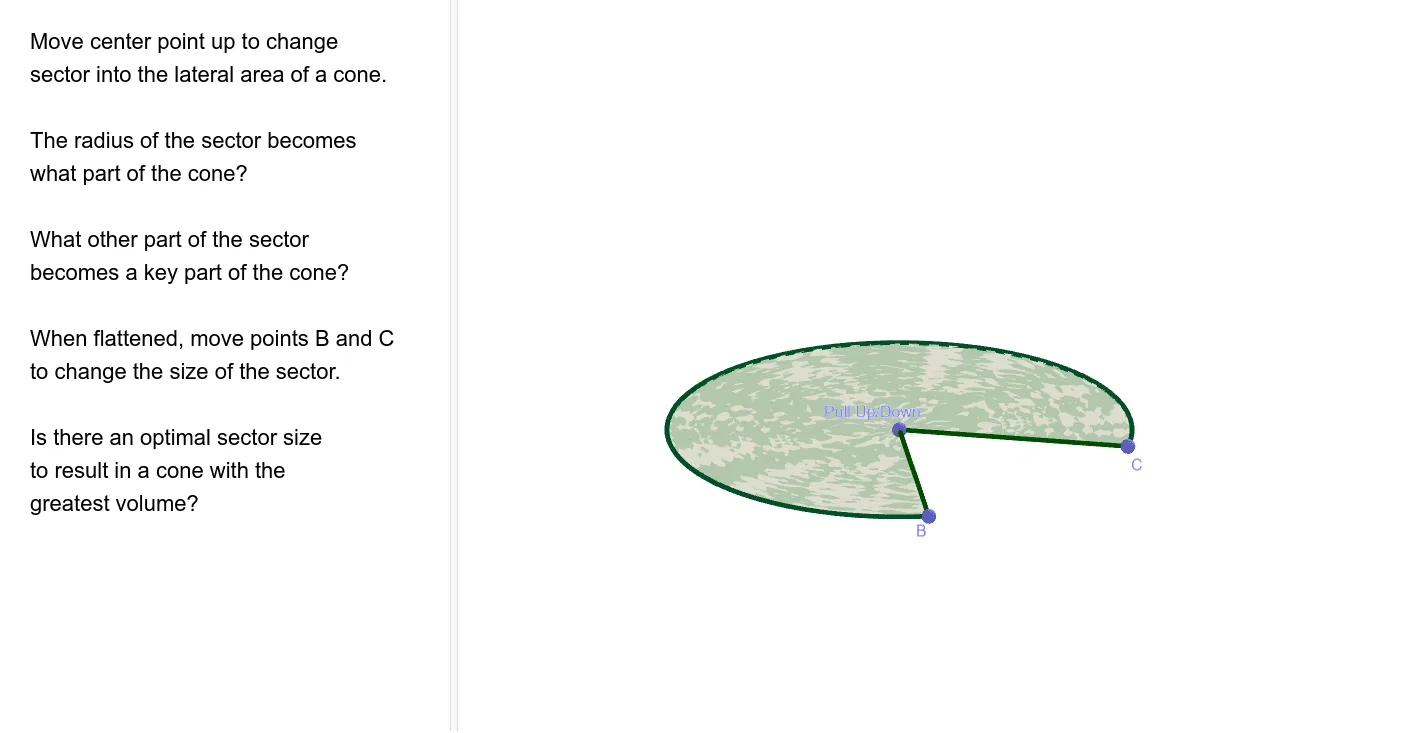
This example demonstrates how to generate a cone by rotating a sector and calculating its lateral area. Core math concepts include sector area, cone lateral surface area, rotational solids, and geometric construction. It utilizes GeoGebra commands like Circle, Point, Rotate, CircumcircleArc, AngularBisector, Sector, Arc, Intersect, Segment, If, Angle, Line, Surface, Cone, and more. Suitable for high school solid geometry education to understand the formation of rotational solids and area calculations.
GeoGebra Commands & Parameters
Circle((0, 0, 0), CircleRad, zAxis) → cPoint(c) → BRotate(B, 0.1°, zAxis) → B'_1Rotate(B, 359°, zAxis) → B'CircumcircleArc(B, B'_1, B') → dPoint(d) → CAngularBisector(C, A, B) → jSector(c, C, B) → gArc(c, C, B) → eCircle(A, ConeRad, zAxis) → hIntersect(j, h) → F, GCircle(C, G, B) → rCircle(C, F, B) → pSegment(A, D) → iPoint(i) → ECircle(A, ChangingRad, zAxis) → qIntersect(r, q) → J, K, ,Intersect(q, p) → H, I, ,If(g < ((0.5 * π) * CircleRad^(2)), K, H) → LSegment(A, L) → sIf(g < ((1 / 2 * π) * CircleRad^(2)), J, I) → MAngle(M, A, L, zAxis) → αLine((0, 0, 0), (0, 0, 1)) → fSegment(L, E) → lSegment(M, E) → mSegment(M, A) → tLine(L, E) → f_1Surface((u * cos(v)), (u * sin(v)), w(u), u, 0, ChangingRad, v, If[Distance[C, M] < Distance[C, L], 360° - α, 0°], If[Distance[C, M] < Distance[C, L], 360°, 360° - α]) → bCone(A, D, ConeRad) → a, k, nRotate(b, (-Angle[L, A, (1, 0, 0), zAxis]), zAxis) → n'Circle(A, ChangingRad, zAxis) → c_1Intersect(j, c_1) → N, OAngle(C, A, B, zAxis) → βIf(β < 180° ∧ α > 180°, CircleArc[A, L, M], If[β < 180° ∧ α < 180°, CircumcircleArc[L, N, M], CircumcircleArc[L, O, M]]) → d_1Segment(A, E) → g_1
AI Drawing Prompt Reference
Draw a rotational solid by rotating a sector around one of its edges to form a cone, then calculate and display the lateral surface area of the cone. Show the calculation process of the sector area and the cone lateral surface area, including constructing key points like the center, vertex, intersection points, and geometric relationships such as rotations, angle bisectors, and arcs, finally presenting the rotational solid and its lateral surface area.
The prompt above was compiled from the original drawing commands and is for reference only.