
Sections of Rectangular Pyramids (G.GGMD.4)
Loading the math board and drawing, please wait…
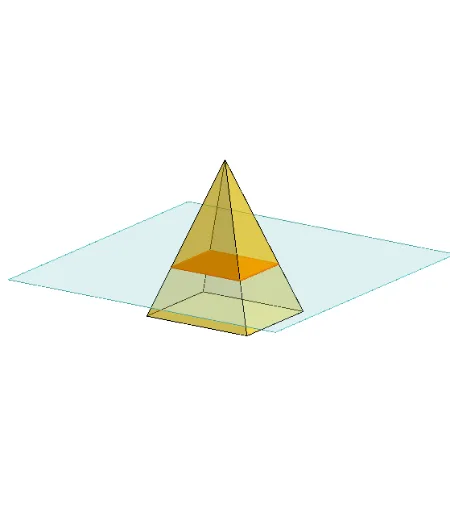
This GeoGebra example investigates how different sections of a rectangular pyramid (four-sided pyramid) change as a cutting plane moves and rotates. It demonstrates the intersection of a plane with a polyhedron, producing cross-sections that vary in shape (triangle, quadrilateral, etc.). Core concepts include solid geometry, plane-section intersections, similarity, and dilation. Construction uses commands such as Polygon, Pyramid, Plane, IntersectPath, Translate, Rotate, and OrthogonalLine, with sliders for dynamic manipulation. Suitable for high school or early college students learning spatial reasoning, cross-section properties, and geometric transformations, as well as for classroom demonstrations or self-study.
GeoGebra Commands & Parameters
Polygon(B + (-2, -2), B + (2, -2), B + (2, 2), B + (-2, 2)) → poly3, e, f, g, iPointIn(poly3) → CTranslate((0, 0, 0), Vector[B, C]) → APolygon(A + (-4, -4), A + (4, -4), A + (4, 4), A + (-4, 4)) → poly1, a, b, c, dRotate(Rotate[Translate[poly1, Vector[A, A + (0, 0, h)]], (90° * s), A + (0, 0, h), yAxis], (90° * t), A, zAxis) → poly2Pyramid(Polygon[(-1.5, -1.25, 0), (1.5, -1.25, 0), (1.5, 1.25, 0), (-1.5, 1.25, 0)], (0, 0, 4)) → m, face1, face2, face3, face4, edge1, edge2, edge3, edge4Rotate(D, 120°, (0, 0, 0)) → EPolygon(D, E, 3, xOyPlane) → poly4, j, k, l, FPointIn(poly2) → GPointIn(poly2) → HPointIn(poly2) → IPlane(G, I, H) → nIntersectPath(n, m) → poly6, poly5, r, a_1, b_1, c_1, K, L_1, O, P, J, L, p, qRotate(m, 0, zAxis) → m'Rotate(m, 0, zAxis) → m'_1OrthogonalLine(A, n) → d_1
AI Drawing Prompt Reference
Draw a rectangular pyramid and then rotate and translate a plane around it to observe the changes in the cross-sectional shapes formed at different positions and angles. First, draw a rectangular base, then construct the pyramid. Next, create a movable plane on the pyramid and observe the cross-sections formed by the intersection of the plane with the pyramid as it is rotated and translated, which will change from triangles to quadrilaterals and other shapes.
The prompt above was compiled from the original drawing commands and is for reference only.