
Sections of a Triangular Prism
Loading the math board and drawing, please wait…
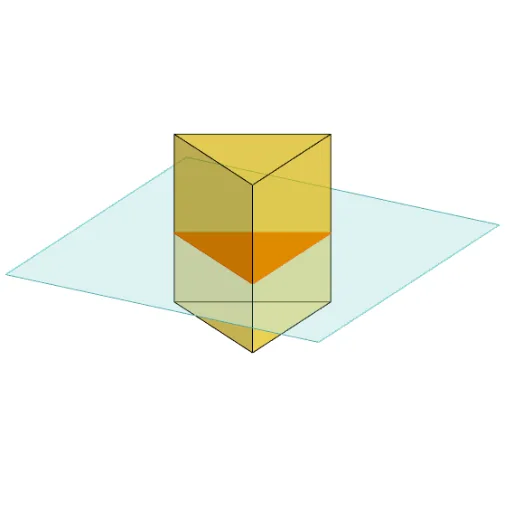
① This example dynamically demonstrates the cross-sections formed when a triangular prism is cut by a plane, illustrating the relationship between cutting planes and polyhedra in solid geometry. ② Core mathematical concepts include the structure of a triangular prism, intersection lines (sections) between a plane and the prism, orthogonal relationships in 3D space, and dynamic variation of the section. ③ Construction highlights: using GeoGebra commands such as Polygon and Prism to build the prism, PointIn to place points on the prism, Translate and Rotate for spatial transformations, Plane to define the cutting plane, IntersectPath to obtain the intersection curve, OrthogonalLine for perpendicular auxiliary lines, and multiple text objects (text1 to text9) for labeling and explanation. ④ Suitable for high school solid geometry classes or introductory university spatial analytic geometry, ideal for classroom demonstrations of section properties, spatial visualization training, and dynamic exploration.
GeoGebra Commands & Parameters
Polygon(B + (-2, -2), B + (2, -2), B + (2, 2), B + (-2, 2)) → poly3, e, f, g, iPointIn(poly3) → CTranslate((0, 0, 0), Vector[B, C]) → APolygon(A + (-4, -4), A + (4, -4), A + (4, 4), A + (-4, 4)) → poly1, a, b, c, dRotate(Rotate[Translate[poly1, Vector[A, A + (0, 0, h)]], (90° * s), A + (0, 0, h), yAxis], (90° * t), A, zAxis) → poly2Rotate(D, 120°, (0, 0, 0)) → EPolygon(D, E, 3, xOyPlane) → poly4, j, k, l, FPrism(poly4, D + (0, 0, 4)) → m, M, edge4, edge5, edge6, N, face1, face2, face3, face4, edge1, edge2, edge3PointIn(poly2) → GPointIn(poly2) → HPointIn(poly2) → IPlane(G, I, H) → nIntersectPath(n, m) → poly6, poly5, r, a_1, b_1, c_1, K, L_1, O, P, J, L, p, qRotate(m, 0, zAxis) → m'Rotate(m, 0, zAxis) → m'_1OrthogonalLine(A, n) → d_1
AI Drawing Prompt Reference
Draw a triangular prism with an equilateral triangle base lying on the horizontal plane and a height of 4 units. Place an inclined rectangular plane above the prism that cuts through its interior, creating a closed intersection curve with the prism. Select three random points on the prism's surface to define this cutting plane. From one vertex of the prism, draw a perpendicular line to the cutting plane to show the orthogonal relationship. The figure includes the prism's edges and faces, the cutting plane, and the polygonal cross-section formed inside the prism. The setup should allow dynamic adjustment of the cutting plane to explore how the section changes.
The prompt above was compiled from the original drawing commands and is for reference only.