
Second Illumination
Loading the math board and drawing, please wait…
In collections
geometriadinamica.es
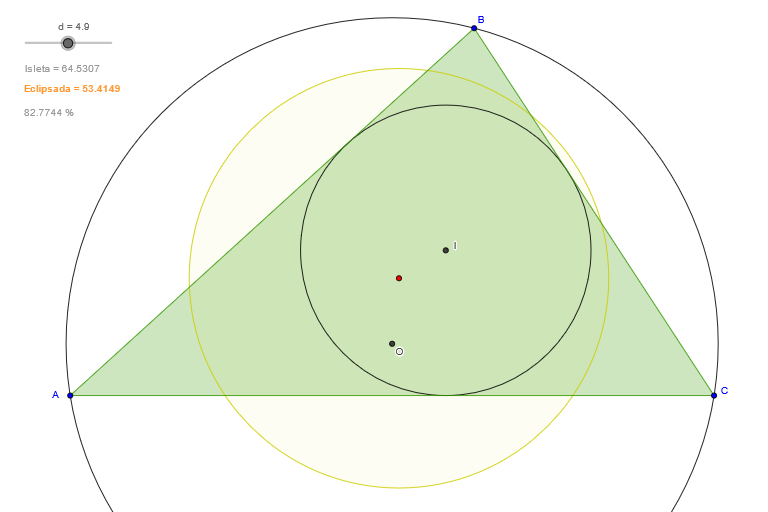
This is an animated example of geometric shapes, demonstrating how to construct a graph containing conic sections and lines using GeoGebra. The core mathematical concepts involved include lines, circles, ellipses, and hyperbolas. The construction points include using Midpoint, Line, AngularBisector, Mirror, and other GeoGebra commands. Suitable for middle school and high school mathematics education, particularly for teaching geometry and algebra.
GeoGebra Commands & Parameters
Midpoint(C, B) → M1Line(A, M1) → mediana1AngularBisector(C, A, B) → bisectrizV1Mirror(mediana1, bisectrizV1) → simediana1OrthogonalLine(A, bisectrizV1) → jAngularBisector(A, C, B) → bisectrizV2Intersect(bisectrizV1, bisectrizV2) → IOrthogonalLine(C, bisectrizV2) → iIntersect(i, j) → I3Intersect(bisectrizV1, i) → I1Polygon(A, C, B) → isleta, v3, v1, v2LineBisector(v2) → mediatriz1LineBisector(v1) → mediatriz2Intersect(mediatriz2, mediatriz1) → OMidpoint(A, B) → M2Line(C, M2) → mediana2Mirror(mediana2, bisectrizV2) → simediana2Intersect(simediana1, simediana2) → LemoineConic(Lemoine, I, I3, I1, O) → h1Focus(h1) → Foco2, Foco1FirstAxisLength(h1) → semiejeHyperbola(Foco1, Foco2, semieje) → hSegment(O, B) → ROrthogonalLine(I, v1) → ortoIIntersect(v1, ortoI) → IbaseSegment(I, Ibase) → rAxes(h1) → eje2, eje1Slope(eje2) → mCenter(h1) → X110OrthogonalLine(G, v3) → g3Intersect(v3, g3) → G3Vector(G, G3) → u3Ray(P, R312) → s312Intersect(v3, s312) → S312Circle(P, d) → circuloPIntersect(circuloP, v3, 1) → P31Intersect(circuloP, v3, 2) → P32Midpoint(P31, P32) → PM3Ray(P, PM3) → sM3Intersect(circuloP, sM3) → PCM3,CircumcircleSector(P31, PCM3, P32) → sector2cEPolygon(P, P31, P32) → tri2c, z2c2, z2c3, z2c1Area(A, C, B) → areaiIntersect(circuloP, v1, 1) → P11If(P11 ≟ P11, true, false) → p11Intersect(circuloP, v1, 2) → P12If(P12 ≟ P12, true, false) → p12Midpoint(P11, P12) → PM1Ray(P, PM1) → sM1Intersect(circuloP, sM1) → PCM1,CircumcircleSector(P11, PCM1, P12) → sector2aEPolygon(P, P11, P12) → tri2a, z2a2, z2a3, z2a1OrthogonalLine(G, v1) → g1Intersect(v1, g1) → G1Vector(G, G1) → u1Ray(P, R112) → s112Intersect(circuloP, s112) → P112, Cir1CircumcircleSector(P11, P112, P12) → sector2aIntersect(v1, s112) → S112If(S112 ≟ S112, sector2a - tri2a, sector2a + tri2a) → area2aIntersect(circuloP, v2, 1) → P22If(P22 ≟ P22, true, false) → p22Intersect(circuloP, v2, 2) → P21If(P21 ≟ P21, true, false) → p21Midpoint(P21, P22) → PM2Ray(P, PM2) → sM2Intersect(circuloP, sM2) → PCM2, Cir2CircumcircleSector(P21, PCM2, P22) → sector2bEPolygon(P, P21, P22) → tri2b, z2b2, z2b3, z2b1OrthogonalLine(G, v2) → g2Intersect(v2, g2) → G2Vector(G, G2) → u2Ray(P, R212) → s212Intersect(circuloP, s212) → P212, Cir3CircumcircleSector(P21, P212, P22) → sector2bIntersect(v2, s212) → S212If(S212 ≟ S212, sector2b - tri2b, sector2b + tri2b) → area2bIf(P32 ≟ P32, true, false) → p32If(P31 ≟ P31, true, false) → p31If(p11 ∧ p12 ∧ p21 ∧ p22 ∧ p31 ∧ p32, true, false) → pos2EIntersect(circuloP, s312) → P312, Cir4CircumcircleSector(P31, P312, P32) → sector2cIf(S312 ≟ S312, sector2c - tri2c, sector2c + tri2c) → area2cIf(pos2E, aread - area2aE - area2bE - area2cE, area2) → area2ESegment(P, A) → dV1Segment(P, C) → dV2Midpoint(A, C) → M3Ray(P, M3) → fuera3Segment(P, B) → dV3If(dV1 ≤ d ∧ dV2 ≤ d ∧ dV3 ≤ d, true, false) → pos5If(pos5, areai, 0) → area5If(area5 < areai, area5, areai) → area5TIntersect(v2, fuera3) → Corte32Intersect(v1, fuera3) → Corte31If(p12 ∧ (¬p11), P12, P11) → P1If(P1 ≟ P1, true, false) → p1If(Distance[P21, P1] > Distance[P22, P1], P22, P21) → P21'Polygon(P, P1, P21') → tri621, ztri621c, ztri621b, ztri621aIf(Distance[P21, P1] > Distance[P22, P1], P21, P22) → P22'If(p22 ∧ (¬p21), P22, P21) → P2Midpoint(P2, P1) → V3bRay(P, V3b) → sV3Intersect(circuloP, sV3, 1) → V3cCircumcircleSector(P2, V3c, P1) → sector1cPolygon(B, P1, P2) → tri1c, z1c2, z1c3, z1c1Polygon(P, P1, P2) → tri01c, z01c2, z01c3, z01c1If(Distance[V3b, B] < dV3 ∧ Distance[A, P] < d, aread - sector1c + tri1c + tri01c, tri1c + sector1c - tri01c) → area1cPolygon(C, A, P2, P1) → cuadri3, zcuadri3a, zcuadri3b, zcuadri3c, zcuadri3dIf(Distance[P11, P2] > Distance[P12, P2], P12, P11) → P11'Polygon(P, P2, P11') → tri611, ztri611b, ztri611a, ztri611cIf(Distance[P11, P2] > Distance[P12, P2], P11, P12) → P12'If(P2 ≟ P2, true, false) → p2If(Distance[P31, P2] > Distance[P32, P2], P32, P31) → P31'Polygon(P, P2, P31') → tri632, ztri632a, ztri632c, ztri632bIf(Distance[P31, P2] > Distance[P32, P2], P31, P32) → P32'Polygon(B, P1, P32', P31', P2) → penta3, zpenta3e, zpenta3d, zpenta3c, zpenta3b, zpenta3aPolygon(P, P1, P32') → tri631, ztri631b, ztri631c, ztri631aIf(p31 ∧ p32 ∧ p1 ∧ p2 ∧ ((¬p11) ∨ (¬p12)) ∧ ((¬p21) ∨ (¬p22)), true, false) → pos6cIf(p11 ∧ p12 ∧ p21 ∧ p22 ∨ p11 ∧ p12 ∧ p31 ∧ p32 ∨ p21 ∧ p22 ∧ p31 ∧ p32, true, false) → pos2If(p32 ∧ (¬p31), P32, P31) → P3Polygon(C, P1, P21', P22', P3) → penta2, zpenta2c, zpenta2b, zpenta2a, zpenta2e, zpenta2dPolygon(P, P3, P22') → tri622, ztri622c, ztri622a, ztri622bMidpoint(P1, P3) → V2bRay(P, V2b) → sV2Intersect(circuloP, sV2, 1) → V2cCircumcircleSector(P1, V2c, P3) → sector1bPolygon(C, P1, P3) → tri1b, z1b2, z1b3, z1b1Polygon(P, P1, P3) → tri01b, z01b2, z01b3, z01b1If(Distance[V2b, C] < dV2 ∧ Distance[A, P] < d, aread - sector1b + tri1b + tri01b, tri1b + sector1b - tri01b) → area1bPolygon(A, B, P1, P3) → cuadri2, zcuadri2a, zcuadri2b, zcuadri2c, zcuadri2dPolygon(A, P2, P11', P12', P3) → penta1, zpenta1a, zpenta1b, zpenta1c, zpenta1d, zpenta1ePolygon(P, P3, P12') → tri612, ztri612c, ztri612b, ztri612aMidpoint(P2, P3) → V1bRay(P, V1b) → sV1Intersect(circuloP, sV1, 1) → V1cCircumcircleSector(P2, V1c, P3) → sector1aPolygon(P, P2, P3) → tri01a, z01a2, z01a3, z01a1Polygon(A, P2, P3) → tri1a, z1a2, tri1a3, z1a1If(Distance[V1b, A] < dV1 ∧ Distance[B, P] < d, aread - sector1a + tri1a + tri01a, tri1a + sector1a - tri01a) → area1aIf(area1a ≟ area1a, area1a, If[area1b ≟ area1b, area1b, area1c]) → area1If(area1 < areai, area1, areai) → area1TPolygon(C, B, P2, P3) → cuadri1, zcuadri1a, zcuadri1b, zcuadri1c, zcuadri1dIf(area4 < areai, area4, areai) → area4TIf(P3 ≟ P3, true, false) → p3If(p21 ∧ p22 ∧ p1 ∧ p3 ∧ ((¬p11) ∨ (¬p12)) ∧ ((¬p31) ∨ (¬p32)), true, false) → pos6bIf((¬p3) ∧ p1 ∧ ((¬p11) ∨ (¬p12)) ∧ p2 ∧ ((¬p21) ∨ (¬p22)), true, false) → pos1cIf((¬p2) ∧ p1 ∧ ((¬p11) ∨ (¬p12)) ∧ p3 ∧ ((¬p31) ∨ (¬p32)), true, false) → pos1bIf((¬p1) ∧ p2 ∧ ((¬p21) ∨ (¬p22)) ∧ p3 ∧ ((¬p31) ∨ (¬p32)), true, false) → pos1aIf(pos1a ∨ pos1b ∨ pos1c, true, false) → pos1If(pos1 ∧ dV2 ≤ d ∧ dV3 ≤ d, true, false) → pos4cIf(pos1 ∧ dV1 ≤ d ∧ dV3 ≤ d, true, false) → pos4bIf(pos1 ∧ dV1 ≤ d ∧ dV2 ≤ d, true, false) → pos4aIf(pos4a ∨ pos4b ∨ pos4c, true, false) → pos4If(p1 ∧ (¬p2) ∧ (¬p3) ∨ (¬p1) ∧ p2 ∧ (¬p3) ∨ (¬p1) ∧ (¬p2) ∧ p3, true, false) → pos3If(p11 ∧ p12 ∧ p2 ∧ p3 ∧ ((¬p21) ∨ (¬p22)) ∧ ((¬p31) ∨ (¬p32)), true, false) → pos6aIf(pos6a ∨ pos6b ∨ pos6c, true, false) → pos6CircumcircleSector(P2, P312, P1) → sector6cIf(pos6c, penta3 + sector6c - sector2c - tri631 - tri632, 0) → area6cCircumcircleSector(P1, P212, P3) → sector6bIf(pos6b, penta2 + sector6b - sector2b - tri621 - tri622, 0) → area6bCircumcircleSector(P2, P112, P3) → sector6aIf(pos6a, penta1 + sector6a - sector2a - tri611 - tri612, 0) → area6aIf(area2E < areai, area2E, areai) → area2TIf(area6 < areai, area6, areai) → area6TRay(P, M2) → fuera2Intersect(v1, fuera2) → Corte21Intersect(v3, fuera2) → Corte23Ray(P, M1) → fuera1Intersect(v3, fuera1) → Corte13Intersect(v2, fuera1) → Corte12Line(B, Lemoine) → simediana3Angle(B, A, C) → αAngle(A, C, B) → βAngle(C, B, A) → γIf(δ ≟ α, M1, If[δ ≟ β, M2, M3]) → MLine(M, Lemoine) → eIf(sector2c > aread / 2, sector2c + tri2c, sector2c) → sector2CIf(areaT > 0 ∨ Corte12 ≟ Corte12 ∨ Corte13 ≟ Corte13 ∨ Corte21 ≟ Corte21 ∨ Corte23 ≟ Corte23 ∨ Corte31 ≟ Corte31 ∨ Corte32 ≟ Corte32, areaT, aread) → areaAngle(isleta) → ε, ζ, ηLine(B, M3) → mediana3Intersect(bisectrizV2, j) → I2Circle(O, R) → circunscritaLine(G, O) → eulerMirror(euler, v2) → euler2Mirror(euler, v1) → euler1Intersect(h1, e, 2) → HIntersect(h1, euler, 1) → JSegment(J, I) → aIntersect(euler, euler1) → EESegment(O, B) → bCircle(I, Ibase) → f
AI Drawing Prompt Reference
Draw a geometric figure including lines, circles, ellipses, and hyperbolas, demonstrating constructions with midpoints, line segments, angle bisectors, and reflections. Start by constructing a triangle, then find its medians, angle bisectors, and perpendicular bisectors to form ellipses and hyperbolas, labeling the foci and center. Add some auxiliary lines and circles to complete the illustration.
The prompt above was compiled from the original drawing commands and is for reference only.