
Secant Angles Outside a Circle
Loading the math board and drawing, please wait…
In collections
Unit 9 - Circles
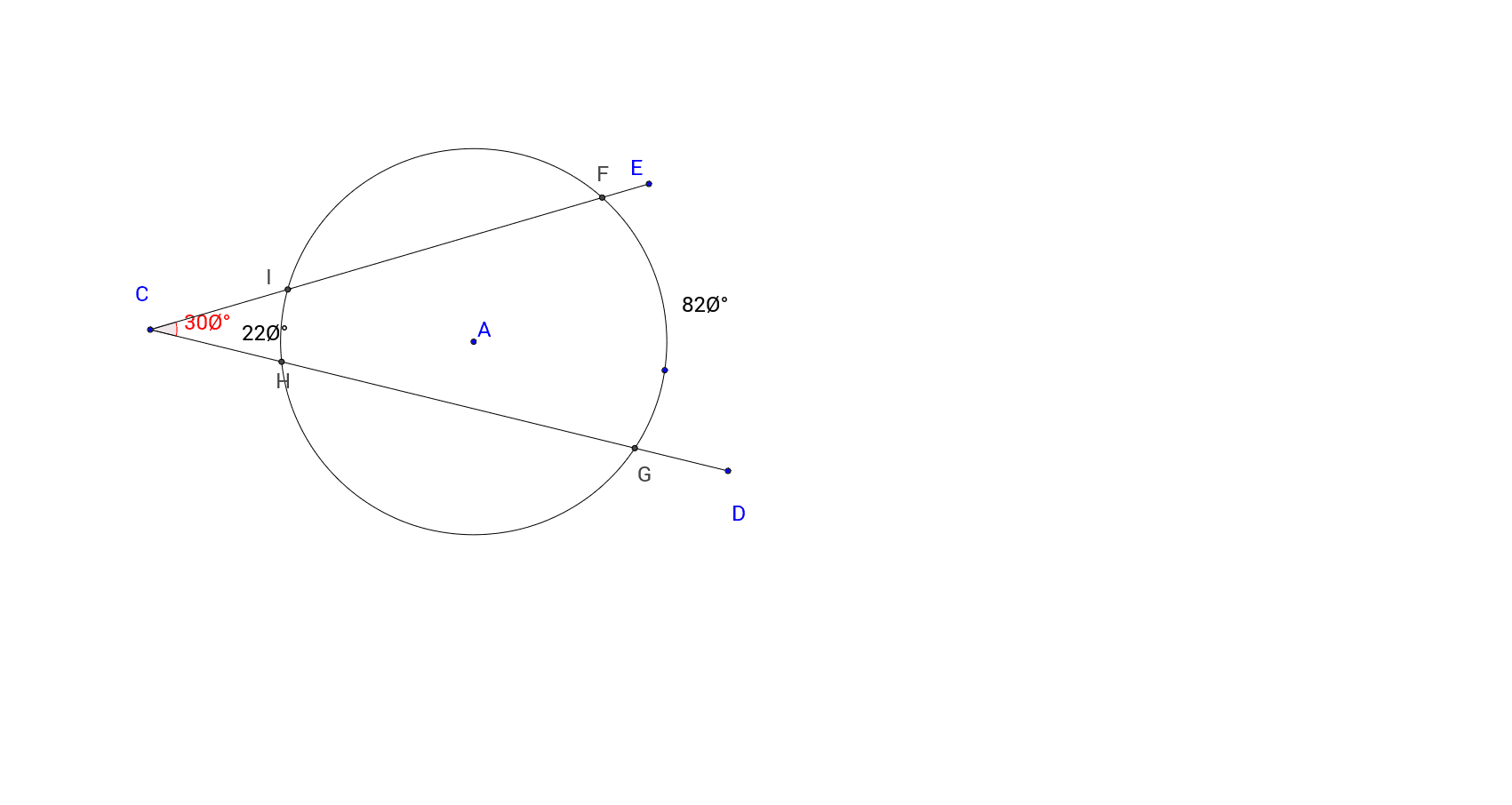
This example demonstrates the relationship between angles formed by secants outside a circle and the arcs they intercept. Key math concepts include the Inscribed Angle Theorem, Secant-Secant Theorem, and the conversion between angles and arcs. Construction highlights involve using GeoGebra commands like Circle, Segment, Intersect, Angle, and AngularBisector to build the geometric figure. Suitable for high school geometry instruction to explore the practical application of the Secant-Secant Theorem.
GeoGebra Commands & Parameters
Circle(A, B) → cSegment(C, D) → aSegment(C, E) → bIntersect(c, b, 2) → FIntersect(c, a, 2) → GIntersect(c, a, 1) → HIntersect(c, b, 1) → IAngle(G, A, F) → αAngle(I, A, H) → βAngle(H, C, I) → γAngularBisector(F, C, G) → dIntersect(c, d, 2) → MIntersect(c, d, 1) → N
AI Drawing Prompt Reference
Draw a circle and two secant lines intersecting outside the circle. Label the points where these lines intersect the circle. Connect one pair of intersection points on the circle. Measure the angles formed by the secants and the circle, as well as the angles between the secants. Find the angle bisector of one of the external angles and mark where it intersects the circle. Connect these intersection points to the center of the circle to form two triangles, and observe the relationships between the angles.
The prompt above was compiled from the original drawing commands and is for reference only.