
Sec 1.6 Basic Constructions:Basic Geometric Constructions
Loading the math board and drawing, please wait…
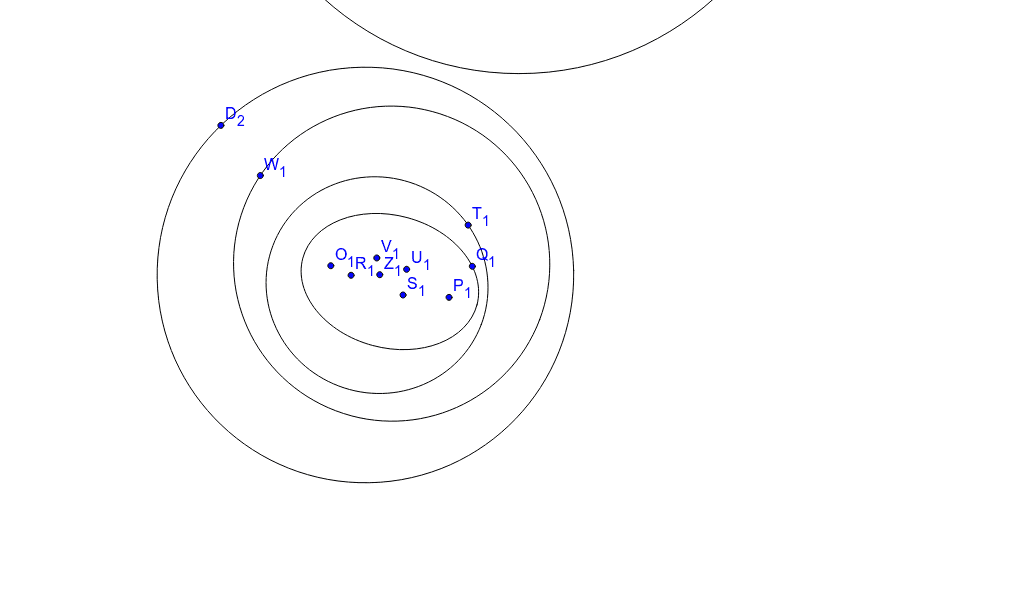
This example demonstrates basic geometric constructions using GeoGebra, including triangles, circles, polygons, and angles. Key mathematical concepts involve geometric construction, coordinate geometry, and transformations. The construction uses commands like Segment, Rotate, Angle, Circle, Intersect, and objects such as Point, Vector, Ellipse. Suitable for middle or high school mathematics to understand geometric construction principles and practical applications.
GeoGebra Commands & Parameters
Segment(A_1, B_1) → aSegment(X_1, Y_1) → bRotate(C_1, 32*°, B_2) → A_2Angle(C_1, B_2, A_2) → αSegment(B_2, A_2) → cSegment(B_2, C_1) → dRotate(C_2, 45*°, B_3) → A_3Angle(C_2, B_3, A_3) → βSegment(B_3, A_3) → eSegment(B_3, C_2) → fSegment(A_4, B_4) → gRotate(D_1, 60*°, A) → D'Angle(D_1, A, D') → γSegment(A, D') → hSegment(A, D_1) → iRotate(Z, 120*°, Y_2) → X_2Angle(Z, Y_2, X_2) → δSegment(X_2, Y_2) → jSegment(Y_2, Z) → kPoint(g) → ECircle(A_4, Segment[A_4, E]) → pCircle(B_4, Segment[A_4, E]) → qIntersect(p, q, 1) → XIntersect(p, q, 2) → YSegment(Y, X) → lIntersect(g, l) → C_3Angle(B_4, C_3, X) → εAngle(X, C_3, B_4) → ζSegment(S, T) → mPoint(m) → FCircle(S, Segment[S, F]) → rCircle(T, Segment[S, F]) → sIntersect(r, s, 1) → GIntersect(r, s, 2) → HSegment(H, G) → nIntersect(m, n) → IPoint(m) → JCircle(S, Segment[S, J]) → tCircle(I, Segment[S, J]) → c_1Intersect(t, c_1, 1) → KIntersect(t, c_1, 2) → LSegment(K, L) → a_1Intersect(m, a_1) → MPoint(h) → BCircle(A, Segment[B, A]) → d_1Intersect(d_1, i, 1) → CCircle(B, Segment[B, C]) → e_1Circle(C, Segment[B, C]) → f_1Intersect(e_1, f_1, 1) → DVector(A, N) → uAngle(C, A, D) → ηAngle(D, A, B) → θPoint(j) → OCircle(P, Q) → g_1Circle(P, R) → h_1Circle(P, U) → k_1Circle(P, V) → p_1Circle(P, W) → q_1Circle(P, E_1) → r_1Circle(P, F_1) → s_1Circle(P, G_1) → t_1Circle(P, H_1) → c_2Circle(P, I_1) → d_2Circle(P, J_1) → e_2Circle(P, K_1) → f_2Circle(P, L_1) → g_2Circle(M_1, N_1) → h_2Ellipse(O_1, P_1, Q_1) → k_2Ellipse(R_1, S_1, T_1) → p_2Ellipse(U_1, V_1, W_1) → q_2Ellipse(Z_1, R_1, D_2) → r_2