
SAS Similarity Theorem Exploration
Loading the math board and drawing, please wait…
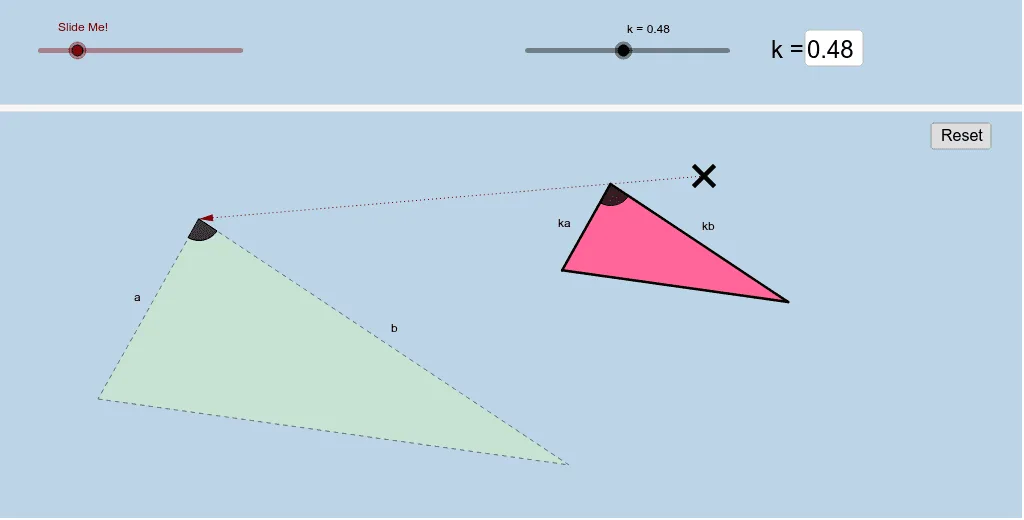
This GeoGebra applet helps students visually understand the SAS Similarity Theorem for triangles. Key mathematical concepts include similar triangles and transformations. Using commands like Segment, Vector, and Dilate, students can explore triangle similarity. Suitable for middle school and above students learning about similar triangles.
GeoGebra Commands & Parameters
Segment(A, B) → aSegment(B, C) → b_2Segment(C, A) → bVector(A, D) → uDilate(A, k, A) → A'Dilate(B, k, A) → B'Segment(A', B') → a'_2Dilate(C, k, A) → C'Dilate(A, k, A) → A'_1Segment(C', A'_1) → c'Dilate(B, k, A) → B'_1Dilate(C, k, A) → C'_1Segment(B'_1, C'_1) → b'_2Polygon(A'_1, B'_1, C'_1) → poly1, c'_1, a'_1, b'_1Dilate(A, m, D) → A'_2Vector(A, A'_2) → vTranslate(A'_1, v) → ETranslate(B'_1, v) → FTranslate(C'_1, v) → GPolygon(E, F, G) → poly1', g, e, fPolygon(A, C, B) → poly2, b_1, a_1, c_1Segment(F, A'_2) → a'Segment(A'_2, G) → b'Segment(G, F) → iAngle(B, A, C) → αVector(D, A) → wCircle(A, 0.5) → pIntersect(p, a) → H,Intersect(p, b) → I,Circle(A'_2, 0.5) → qIntersect(q, a', 1) → JIntersect(q, b', 1) → KCircleSector(A'_2, J, K) → rCircleSector(A, H, I) → sAngle(H, A, I) → βCircleSector(A, I, H) → tCircleSector(A'_2, K, J) → d_1Circle(B, 0.5) → cCircle(F, 0.5) → dIntersect(c, b_2, 1) → LIntersect(c, a, 1) → MIntersect(d, i, 1) → NIntersect(d, a', 1) → OCircleSector(F, N, O) → hCircleSector(B, L, M) → e_1CircleSector(F, O, N) → f_1Dilate(F, 1 - j, B) → F'Vector(F, F') → lTranslate(h, l) → h'Translate(f_1, l) → g_1Textfield(k) → InputBox1
AI Drawing Prompt Reference
Draw two similar triangles, one original and one dilated, connected by vectors from vertices to a central point, showing the dilation transformation process. The original triangle is formed by connecting three points with line segments, and the dilated triangle is obtained by scaling the vertices of the original triangle, then connecting corresponding vertices with line segments. Add angle markings and sectors to emphasize that corresponding angles of similar triangles are equal, and use circles and intersection points to illustrate vector relationships and transformation effects.
The prompt above was compiled from the original drawing commands and is for reference only.