
Rotational Symmetry: Dynamic Geometric Demonstration
Loading the math board and drawing, please wait…
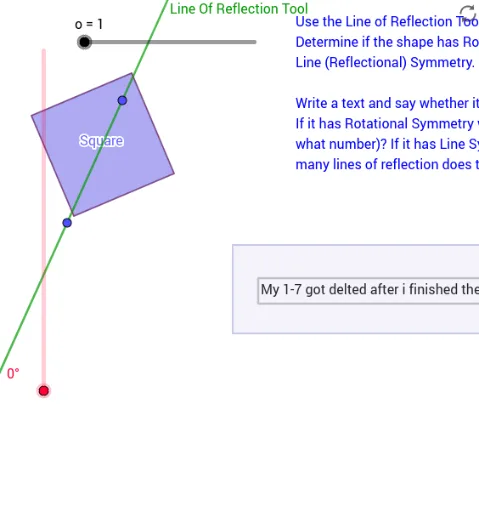
① This GeoGebra example dynamically demonstrates a geometric figure with rotational symmetry, allowing users to observe how the shape coincides with itself after rotation about a center. ② Core mathematical concepts include rotational symmetry, symmetry transformations, angle measurement, and combinations of polygons and circles, involving rotation centers, rotation angles, and symmetry axes. ③ Construction highlights: Based on the construction summary, commands such as Segment, OrthogonalLine, Point, Intersect, Polygon, Circle, Line, Rotate, Mirror, and Angle are used, creating multiple points, lines, circles, and polygons (e.g., A, B, poly1, c_1) and building symmetric structures through rotation and reflection operations. ④ Suitable for middle and high school geometry classes, this example is ideal for teaching rotational symmetry, symmetry of regular polygons, and transformation geometry, and can serve as a mathematical experiment or inquiry activity to help students grasp the mathematical essence of symmetry.
GeoGebra Commands & Parameters
Segment(A, B) → aOrthogonalLine(A, a) → bOrthogonalLine(B, a) → cPoint(b) → COrthogonalLine(C, b) → dIntersect(c, d) → DPolygon(C, D, B, A) → poly1, c_1, d_1, b_1, a_1Segment(C, B) → eSegment(D, A) → fIntersect(e, f) → EPolygon(F, G, 4) → poly2, f_1, g, h, i, H, ISegment(I, G) → jSegment(H, F) → kIntersect(j, k) → JSegment(K, L) → lCircle(K, L) → pPoint(p) → MSegment(K, M) → mLine(M, l) → nLine(L, m) → qIntersect(n, q) → NSegment(M, L) → rSegment(N, K) → sIntersect(r, s) → OPolygon(M, N, L, K) → poly3, m_1, n_1, l_1, k_1Rotate(C, (-α), E) → C'Rotate(D, (-α), E) → D'Rotate(B, (-α), E) → B'Rotate(A, (-α), E) → A'Polygon(C', D', B', A') → Rectangle, c', d', b', a'Rotate(M, (-α), O) → M'Rotate(N, (-α), O) → N'Rotate(L, (-α), O) → L'Rotate(K, (-α), O) → K'Polygon(M', N', L', K') → Rhombus, m', n', l', k'Segment(P, Q) → tSegment(P, R) → e_1Line(Q, e_1) → g_1Line(R, t) → h_1Intersect(g_1, h_1) → SPolygon(P, R, S, Q) → poly4, p_1, r_1, s_1, q_1Segment(R, Q) → i_1Segment(S, P) → j_1Intersect(i_1, j_1) → TRotate(P, (-α), T) → P'Rotate(R, (-α), T) → R'Rotate(S, (-α), T) → S'Rotate(Q, (-α), T) → Q'Polygon(P', R', S', Q') → Parallelogram, p', r', s', q'Segment(U, V) → t_1Segment(U, W) → a_2Line(W, t_1) → b_2Point(b_2) → ZSegment(Z, V) → c_2Polygon(U, V, Z, W) → poly5, u, v, z, wSegment(W, V) → d_2Segment(Z, U) → e_2Intersect(d_2, e_2) → A_1Rotate(U, (-α), A_1) → U'Rotate(V, (-α), A_1) → V'Rotate(Z, (-α), A_1) → Z'Rotate(W, (-α), A_1) → W'Polygon(U', V', Z', W') → Trapezoid, u', v', z', w'Line(B_1, C_1) → f_2Mirror(D_1, f_2) → E_1Polygon(D_1, B_1, E_1, C_1) → poly6, d_3, b_3, e_3, c_3Segment(D_1, E_1) → g_2Intersect(f_2, g_2) → F_1Rotate(D_1, (-α), F_1) → G_1Rotate(B_1, (-α), F_1) → H_1Rotate(E_1, (-α), F_1) → I_1Rotate(C_1, (-α), F_1) → J_1Polygon(G_1, H_1, I_1, J_1) → Kite, g_3, h_2, i_2, j_2Rotate(poly2, (-α), J) → SquareLine(K_1, L_1) → k_2Circle(M_1, N_1) → CircleRotate(N_1, α, M_1) → O_1Angle(N_1, M_1, O_1) → βPolygon(P_1, Q_1, 5) → poly7, l_2, m_2, n_2, p_2, q_2, R_1, S_1, T_1Line(P_1, T_1) → r_2Line(R_1, S_1) → s_2Line(S_1, T_1) → t_2Line(Q_1, P_1) → f_3Line(R_1, Q_1) → h_3Intersect(s_2, r_2) → U_1Intersect(t_2, f_3) → V_1Intersect(r_2, h_3) → W_1Intersect(f_3, s_2) → Z_1Intersect(h_3, t_2) → A_2Intersect(r_2, t_2) → B_2Intersect(f_3, r_2) → C_2Intersect(h_3, f_3) → D_2Intersect(s_2, h_3) → E_2Intersect(s_2, t_2) → F_2Polygon(U_1, B_2, V_1, C_2, W_1, D_2, Z_1, E_2, G_2, F_2) → poly8, u_1, f_4, b_4, v_1, c_4, w_1, d_4, z_1, e_4, g_4Line(H_2, I_2) → i_3Mirror(J_2, i_3) → O_2Mirror(K_2, i_3) → P_2Mirror(L_2, i_3) → Q_2Mirror(M_2, i_3) → R_2Mirror(N_2, i_3) → S_2Polygon(J_2, O_2, P_2, Q_2, R_2, S_2, N_2, M_2, L_2, T_2) → poly9, j_3, t_3, o_2, p_3, q_3, r_3, s_3, n_3, m_3, l_3
AI Drawing Prompt Reference
Draw a geometric figure with rotational symmetry, including a quadrilateral ABCD and a rhombus EFGH. First, connect points A and B, B and C, C and D, D and A to form quadrilateral ABCD. Then, construct the symmetric figure A'B'C'D' of quadrilateral ABCD with rotation center E and rotation angle -α. Next, construct a rhombus EFGH with diagonals intersecting at point O, and then construct the symmetric figure E'F'G'H' of rhombus EFGH with rotation center O and rotation angle -α. Finally, construct a quadrilateral PQRS with diagonals intersecting at point T, and then construct the symmetric figure P'Q'R'S' of quadrilateral PQRS with rotation center T and rotation angle -α.
The prompt above was compiled from the original drawing commands and is for reference only.