
Rotating Hexagon
Loading the math board and drawing, please wait…
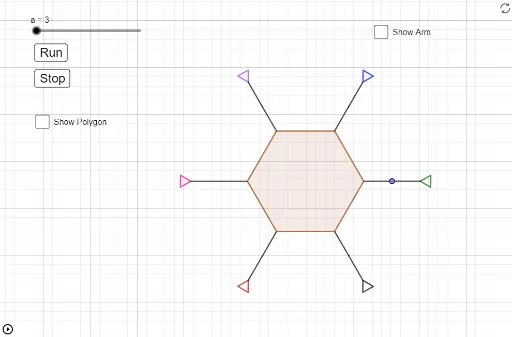
This example demonstrates the rotation of a hexagon. Key mathematical concepts include rotation, symmetry, circle, and trigonometry. Using GeoGebra commands such as Circle, Point, Segment, Line, Rotate, etc., a dynamic model of a rotating hexagon is constructed. Suitable for high school mathematics education, particularly in geometry and trigonometry.
GeoGebra Commands & Parameters
Circle(A, B) → cPoint(c) → CSegment(A, C) → fPoint(c) → DLine(A, D) → gOrthogonalLine(C, g) → hMirror(A, h) → A'Mirror(C, h) → C'Segment(A', C') → f'Point(g) → ECircle(E, A) → dPolygon(F, G, a) → poly1, i, s, t, b, H, I, J, K, L, M, N, j, O, P, Q, k, l, m, n, p, q, rVector(H, A') → uTranslate(poly1, u) → poly1'Rotate(poly1', 60°, E) → poly1''Rotate(A, 60°, E) → A'_1Rotate(C, 60°, E) → C'_1Segment(A'_1, C'_1) → f'_1Rotate(A', 60°, E) → A''Rotate(C', 60°, E) → C''Segment(A'', C'') → f''Rotate(poly1'', 60°, E) → poly1'''Rotate(A'_1, 60°, E) → RRotate(C'_1, 60°, E) → SSegment(R, S) → eRotate(A'', 60°, E) → A'''Rotate(C'', 60°, E) → C'''Segment(A''', C''') → f'''Rotate(poly1''', 60°, E) → t1Rotate(R, 60°, E) → R'Rotate(S, 60°, E) → S'Segment(R', S') → e'Rotate(A''', 60°, E) → TRotate(C''', 60°, E) → USegment(T, U) → f_1Rotate(t1, 60°, E) → t1'Rotate(R', 60°, E) → R''Rotate(S', 60°, E) → S''Segment(R'', S'') → e''Rotate(T, 60°, E) → T'Rotate(U, 60°, E) → U'Segment(T', U') → g_1Rotate(t1', 60°, E) → t1''Rotate(R'', 60°, E) → R'''Rotate(S'', 60°, E) → S'''Segment(R''', S''') → e'''Rotate(T', 60°, E) → T''Rotate(U', 60°, E) → U''Segment(T'', U'') → h_1Polygon(R, R', R'', R''', A, A'_1) → poly2, r_1, r', r'', r''', a_1, a'_1Circle(W, Z) → c_1Point(c_1) → A_1Point(c_1) → B_1Segment(A_1, B_1) → i_1Point(c_1) → C_1Segment(W, C_1) → j_1OrthogonalLine(C_1, i_1) → k_1Mirror(W, k_1) → W'Mirror(C_1, k_1) → D_1Segment(W', D_1) → l_1
AI Drawing Prompt Reference
Draw a rotating hexagon to demonstrate the concepts of rotation, symmetry, circle, and trigonometry. Start by drawing a circle and marking points on it to form one side of the hexagon. Then, rotate this side and the points to progressively build the rotating hexagon, showing its dynamic transformation.
The prompt above was compiled from the original drawing commands and is for reference only.