
Roots of Complex Numbers as Vectors
Loading the math board and drawing, please wait…
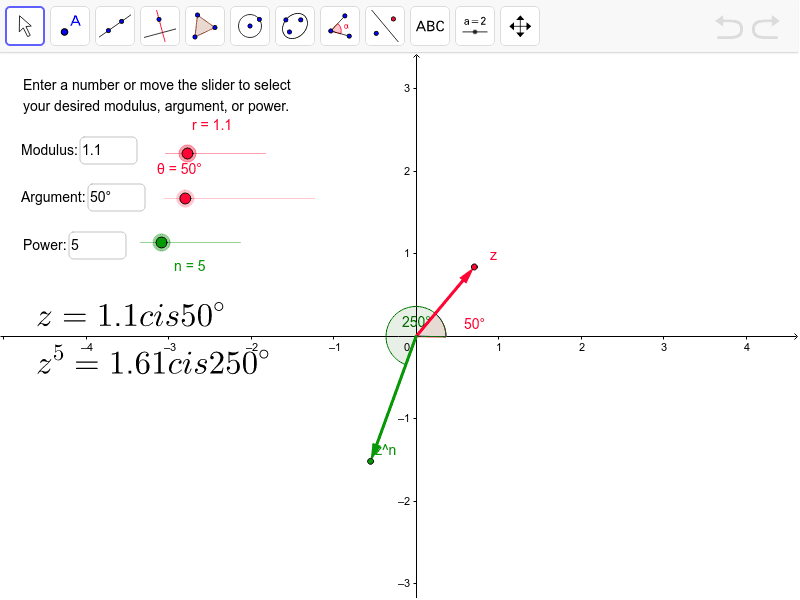
This example demonstrates how the roots of complex numbers are represented as vectors, visualizing their geometric interpretation. Key math concepts include complex numbers, modulus, argument, power operations, isosceles triangles, and vectors. It constructs objects like θ, r, z, v, A, O, α, n, z_n, v_n, Modulus, Argument, Power using GeoGebra commands Vector, Angle, Textfield. Suitable for high school and above students to understand the geometric meaning of complex number operations and vector representations.
GeoGebra Commands & Parameters
Vector(z) → vAngle(A, O, z) → αVector(z_n) → v_nTextfield(r) → ModulusTextfield(θ) → ArgumentTextfield(n) → PowerAngle(A, O, z_n) → β
AI Drawing Prompt Reference
Draw a geometric interpretation of the roots of complex numbers as vectors, showing the modulus and argument of complex numbers and representing the roots as vectors. Start by plotting an origin and a complex number point, then draw a vector for the complex number and label its modulus and argument. Next, based on the modulus and argument, draw the n-th roots of the complex number and represent each root as a vector, labeling the modulus and argument of each root. Finally, connect the origin to each root to form isosceles triangles, demonstrating the symmetry of the roots.
The prompt above was compiled from the original drawing commands and is for reference only.