
Root Form from Graph
Loading the math board and drawing, please wait…
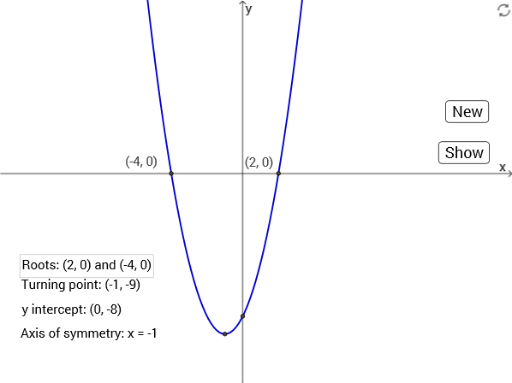
This GeoGebra example demonstrates how to derive the root form (factored form) of a quadratic function directly from its graph by reading the two x-intercepts (roots) and the y-intercept. The core mathematical concepts include the factored form of quadratics, the relationship between roots and coefficients, the axis of symmetry, and the vertex coordinates. Construction details: the Random command generates random parameters, Intersect finds the roots (Root_1, Root_2) and the y-intercept, Extremum locates the vertex (TP), and the axis of symmetry (LoS) is drawn. A ShowAnswers toggle reveals the final equation for self-checking. This is suitable for middle or high school students learning to convert between graphical and algebraic representations of quadratic functions, either in classroom demonstrations or independent practice.
GeoGebra Commands & Parameters
Random(-5, 5) → mRandom(-5, 5) → nIntersect(c, xAxis, 2) → Root_1Intersect(c, xAxis, 1) → Root_2Intersect(c, yAxis, 1) → yinterceptExtremum(((x + m) * (x + n))) → TP