
Right Triangle Trig: Solving for Sides (2)
Loading the math board and drawing, please wait…
In collections
Geometry Review
GCSE Higher Ch5 Angles & Trigonometry
Unit 9: Right Triangles and Trigonometry
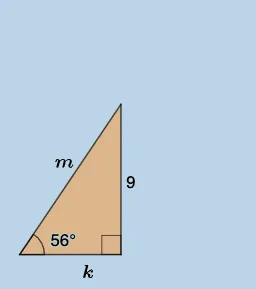
This example demonstrates solving for unknown sides in a right triangle given an angle and one side, focusing on the application of sine, cosine, and tangent functions. Key math concepts include triangle properties and trigonometric ratios. GeoGebra commands like Point, Sequence, Rotate, Intersect, and Segment are used to construct the triangle dynamically. Suitable for high school students learning trigonometric applications in real-world problems.
GeoGebra Commands & Parameters
Point(yAxis) → ASequence(i, i, 3, 10, 1) → opplist, {3, 4, 5, 6, 7, 8, 9, 10}Random(1, 3) → nRandomElement(opplist) → oppSequence(i, i, 3, 8, 1) → adjlist, {3, 4, 5, 6, 7, 8}RandomElement(adjlist) → adjSequence(i, i, 3, 13, 1) → hyplist, {3, 4, 5, 6, 7, 8, 9, 10, 11, 12, 13}RandomElement(hyplist) → hypRandom(35, 65) → angRotate(B, (ang * π / 180), A) → B'Ray(A, B') → fIntersect(f, eq1) → DAngle(B, A, B') → αSegment(C, D) → gPolygon(A, C, D) → t1, d, a, cAngle(D, C, A) → βIntersect(eq2, f) → FPolygon(A, E, F) → t2, f_1, a_1, eAngle(F, E, A) → γSegment(A, E) → hCircle(A, hyp) → kIntersect(k, f) → G,Intersect(eq3, xAxis) → HSegment(G, H) → iSegment(A, G) → jPolygon(A, G, H) → t3, h_1, a_2, g_1Segment(A, H) → lAngle(G, H, A) → δSegment(A, D) → mSegment(A, C) → pSegment(A, F) → qSegment(F, E) → rTextfield(jans) → InputBox1Textfield(kans) → InputBox2Textfield(hypans) → InputBox3If(jcorrect, "√", "X") → text8If(mcorrect, "√", "X") → text9If(kcorrect, "√", "X") → text10Textfield(jansa) → InputBox4Textfield(kansa) → InputBox5Textfield(hypansa) → InputBox6If(jacorrect, "√", "X") → text2If(kacorrect, "√", "X") → text3If(hypacorrect, "√", "X") → text4
AI Drawing Prompt Reference
Draw a right triangle with a known acute angle and one side length, demonstrating how to solve for the unknown sides dynamically. The triangle has three vertices and three sides, with one vertex on the y-axis. Randomly select from three possible leg lengths and four possible hypotenuse lengths, then rotate the right triangle to change the angle. Show the angles with dashed lines and display three sub-triangles, each labeled with corresponding side lengths and angles. Finally, construct auxiliary lines using a circle and a ray, and label the calculated results.
The prompt above was compiled from the original drawing commands and is for reference only.