
Rhombus Stars: A Geometric Pattern with Linear and Quadratic Functions
Loading the math board and drawing, please wait…
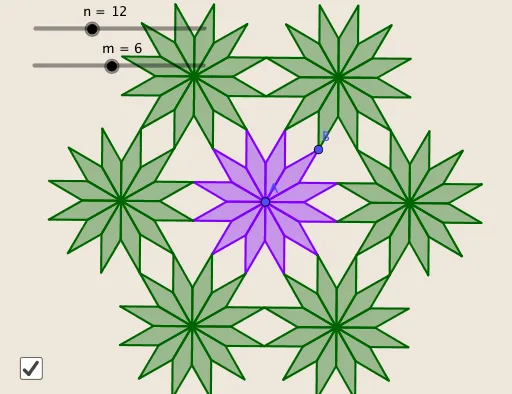
This GeoGebra example demonstrates a star-shaped pattern formed by multiple rhombi arranged around a central point, created as an interactive geometric pattern (IGP). The core mathematical concepts include properties of rhombi, graphs of linear and quadratic functions, symmetry and rotation in plane geometry, and the influence of integer parameters on the pattern's form. The construction uses GeoGebra commands such as LineBisector and Intersect to determine key points, Polygon to build each rhombus, and Sequence combined with Rotate to generate multiple rotated copies. Midpoint and function objects (e.g., f, g) are employed to adjust size and position. This example is suitable for middle and high school students learning geometric transformations, function graphing, and pattern design, and can be used in math enrichment or art-integrated lessons to foster intuitive understanding of rotational symmetry and parametric construction.
GeoGebra Commands & Parameters
LineBisector(A, B) → fIntersect(f, Ray[A, Rotate[B, (180°) / n, A]]) → CPolygon(A, C, B, Mirror[C, Line[A, B]]) → q1, a, c, b, gSequence(Rotate[q1, (i * (360°) / n), A], i, 0, n - 1) → l1Midpoint(B, Rotate[B, (360°) / n, A]) → DRotate(l1, 180°, D) → l1'Sequence(Rotate[l1', (i * (360°) / m), A], i, 0, m - 1) → l2