
Rhombus Properties and Construction by julianastakhov
Loading the math board and drawing, please wait…
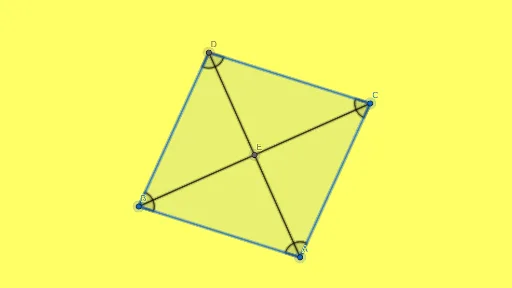
This example demonstrates the properties of a rhombus and its geometric construction. Key mathematical concepts include the definition of a rhombus, equal sides, perpendicular diagonals, and angle relationships. Construction involves using GeoGebra commands like Circle, Point, Intersect, and InteriorAngles to create and verify the rhombus. Suitable for middle school students learning geometry fundamentals or for educational purposes.
GeoGebra Commands & Parameters
Circle(A, B) → cPoint(c) → CCircle(B, A) → dCircle(C, A) → eIntersect(d, e, 2) → DPolygon(A, C, D, B) → q1, a, c_1, d_1, bInteriorAngles(q1) → α, β, γ, δSegment(B, C) → fSegment(A, D) → gIntersect(g, f) → EAngle(C, E, D) → εAngle(E, B, D) → ζAngle(A, B, E) → ηDistance(E, A) → distanceEADistance(E, D) → distanceED
AI Drawing Prompt Reference
Draw a rhombus by first creating a circle centered at one endpoint of a side with radius equal to that side, then another circle centered at the other endpoint with the same radius. Pick a point on the first circle as the third vertex, draw a circle centered at that point with the same radius, and intersect it with the second circle to get the fourth vertex. Connect the four vertices to form the rhombus, label its interior angles. Draw both diagonals, mark their intersection, measure the distances from this intersection to two opposite vertices, and label the angles formed between the diagonals and sides.
The prompt above was compiled from the original drawing commands and is for reference only.