
Resultant Vectors: Vector Addition Visualization
Loading the math board and drawing, please wait…
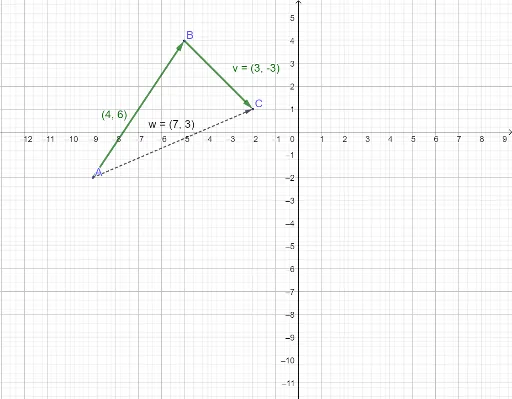
This GeoGebra example dynamically demonstrates the resultant of two or more vectors, visually illustrating the geometric meaning of vector addition. The core mathematical concepts include vector addition using the triangle law and parallelogram law, as well as vector representation in both 2D and 3D spaces. Construction highlights: the Vector command is used to create vectors u, v, and w, with points A, B, C serving as origins or terminals; by dragging these points or sliders, users can observe how the resultant vector changes with the components. Suitable for high school or early college students learning vector operations, force composition in physics, and as an introductory visualization tool for linear algebra. The construction is simple and clear, ideal for classroom demonstrations or self-guided exploration of properties such as commutativity and associativity of vector addition.
GeoGebra Commands & Parameters
Vector(A, B) → uVector(B, C) → vVector(A, C) → w