
Resultant of Two Vectors in 3D
Loading the math board and drawing, please wait…
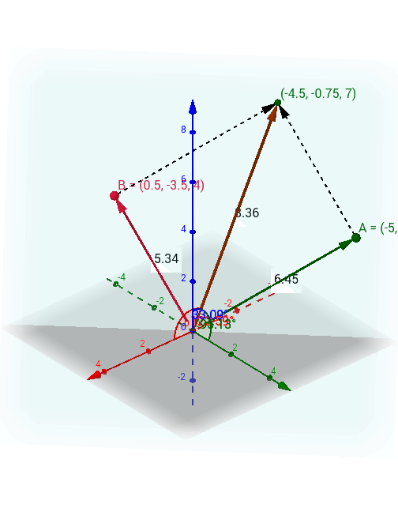
This example demonstrates the resultant of two vectors in 3D space. Key mathematical concepts include vector addition. The construction uses commands such as Vector, Plane, Distance, Translate, and Angle. Suitable for high school and above students to learn the geometric meaning and operations of vectors.
GeoGebra Commands & Parameters
Vector(C, A) → uVector(C, B) → vPlane(B, C, A) → aDistance(C, A) → distanceCADistance(C, B) → distanceCBTranslate(A, v) → A'_1Vector(A, A'_1) → bTranslate(B, u) → B'_1Vector(B, B'_1) → cDistance(C, A'_1) → distanceCA'1Angle(X', C, A'_1) → αAngle(Y', C, A'_1) → βAngle(Z', C, A'_1) → γ
AI Drawing Prompt Reference
Draw the resultant vector of two vectors u and v in 3D space. Start by defining vectors u and v, then create a plane a using points C, A, and B. Calculate the distances CA and CB, and translate point A along vector v to get A'1, then calculate the distance from A to A'1 and angles α, β, and γ. Finally, translate point B along vector u to get B'1, and calculate the distance from B to B'1.
The prompt above was compiled from the original drawing commands and is for reference only.