
Remote Interior Angles of an Exterior Angle
Loading the math board and drawing, please wait…
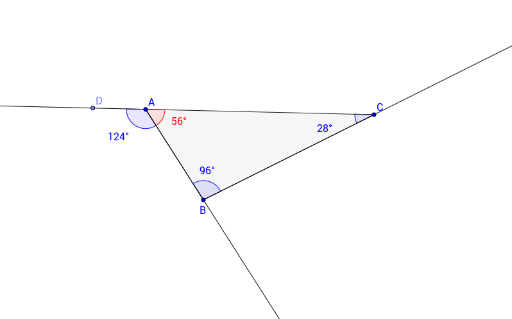
This example demonstrates the relationship between an exterior angle of a polygon and its two non-adjacent interior angles (remote interior angles). Key math concepts include the exterior angle theorem, angle sum, and triangle angle sum. It uses commands like Polygon, Line, Point, Angle, Ray to construct the necessary geometric elements. Suitable for high school mathematics education to visually illustrate the exterior angle theorem and its applications.
GeoGebra Commands & Parameters
Polygon(A, B, C) → poly1, c, a, bLine(A, C) → dPoint(d) → DAngle(D, A, B) → αAngle(C, B, A) → βAngle(A, C, B) → γAngle(B, A, C) → δRay(A, D) → fRay(A, B) → gRay(B, C) → h
AI Drawing Prompt Reference
Draw a triangle and extend one of its sides to create an exterior angle. Start by constructing the triangle, then extend a side from one vertex outward to form the exterior angle. Label the exterior angle and the two non-adjacent interior angles of the triangle. Use rays to show the extended side and clearly mark all relevant angles to illustrate that the exterior angle equals the sum of the two remote interior angles.
The prompt above was compiled from the original drawing commands and is for reference only.