
Relative motion in 2D
Loading the math board and drawing, please wait…
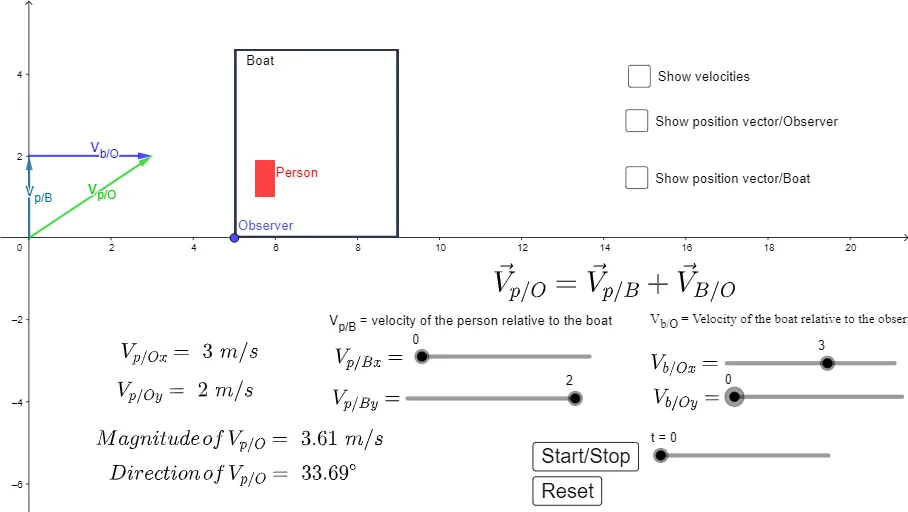
This example demonstrates relative motion in 2D space by showing the movement of two objects through vector translation and coordinate transformation. Key mathematical concepts include vector operations, coordinate system transformations, and geometric transformations. Construction involves using GeoGebra commands like Vector, Translate, and Point to build motion trajectories. Suitable for high school students learning vector geometry and coordinate geometry.
GeoGebra Commands & Parameters
Vector(D, I) → wTranslate(w, D) → vpersonPoint(vperson, 1) → NVector(D, C) → sSurface(s + w, u_{1}, -10, 10, v_{1}, -10, 10) → fTranslate(w, G) → uuTranslate(s, E) → uVector(D, K) → zzTranslate(s, N) → vboatPoint(vboat, 1) → MVector(A, G) → pVector(A, E) → pp
AI Drawing Prompt Reference
Demonstrate relative motion in 2D space by showing the movement of two objects through vector translation and coordinate transformation. Start by drawing a vector, then translate it and mark the start and end points. Next, use this vector to generate a surface, create two new vectors, and translate them separately. Finally, mark the endpoints of the translations to show the relative motion of the objects.
The prompt above was compiled from the original drawing commands and is for reference only.