
Relationship Among Three Inradii in a Right Triangle
Loading the math board and drawing, please wait…
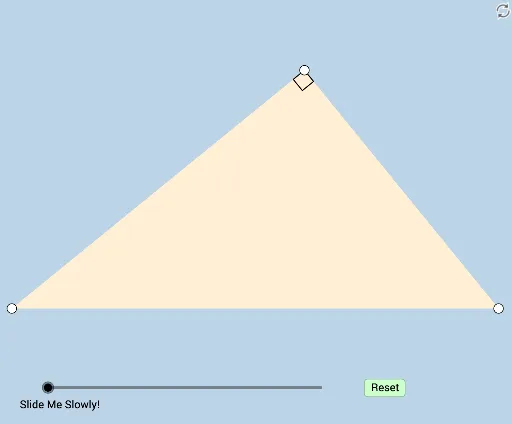
This example illustrates the relationship among the inradii of three different triangles within a right triangle. Key mathematical concepts include geometric mean and circles. Using GeoGebra commands such as semicircle, point, segment, angle, line, orthogonal line, intersect, rotate, ray, polygon, dilate, minimum, circle arc, vector, translate, midpoint, circle sector, and more, the dynamic relationship is demonstrated. Suitable for middle school and above students to learn geometric construction and properties of circles.
GeoGebra Commands & Parameters
Semicircle(A, B) → cPoint(c) → CSegment(A, C) → fSegment(C, B) → gSegment(B, A) → hAngle(A, C, B) → αLine(C, A) → iLine(C, B) → jLine(A, B) → kOrthogonalLine(C, k) → lIntersect(k, l) → DOrthogonalLine(D, j) → mOrthogonalLine(D, i) → nIntersect(j, m) → EIntersect(i, n) → FAngle(D, E, B) → βAngle(A, F, D) → γLine(F, E) → pAngle(B, A, C) → δRotate(B, δ / 2, A) → B'Angle(B, A, B') → εAngle(C, B, A) → ζRotate(C, ζ / 2, B) → C'Angle(C, B, C') → ηLine(D, E) → qLine(D, F) → rRay(B, C') → sIntersect(q, s) → GRay(A, B') → tIntersect(r, t) → HRay(B, G) → aLine(D, a) → bIntersect(i, b) → IRay(A, H) → dIntersect(b, d) → JLine(D, t) → eIntersect(e, s) → KAngle(F, E, D) → θAngle(D, F, E) → λRotate(E, (-(λ / 2)), F) → E'Angle(E', F, E) → ωRay(F, E') → f_1Rotate(F, θ / 2, E) → F'Angle(F, E, F') → κRay(E, F') → g_1Intersect(f_1, g_1) → LAngle(C, D, A) → μPolygon(A, C, B) → poly1, b_1, a_1, c_1Dilate(C, If[0 < o ≤ 1, 1 - o, 0], D) → C'_1Segment(C, C'_1) → h_1Dilate(D, If[1 < o ≤ 2, 2 - o, 0], F) → D'Dilate(D, If[1 < o ≤ 2, 2 - o, 0], E) → D'_1Segment(D, D'_1) → i_1Segment(D, D') → j_1Segment(A, J) → k_1Segment(D, J) → l_1Segment(D, K) → m_1Segment(B, K) → n_1Segment(F, L) → p_1Segment(E, L) → q_1Min({k_1, l_1, m_1, n_1, q_1, p_1}) → uCircle(A, (0.4 * u)) → d_1Circle(D, (0.4 * u)) → e_1Circle(B, (0.4 * u)) → r_1Circle(E, (0.4 * u)) → s_1Circle(F, (0.4 * u)) → t_1Intersect(d_1, k) → M, NIntersect(d_1, k_1) → O,Intersect(e_1, l_1) → P,Intersect(e_1, k) → Q, RIntersect(e_1, m_1) → S,Intersect(r_1, k) → T, UIntersect(r_1, n_1) → V,Intersect(t_1, j_1, 1) → WIntersect(t_1, p_1, 1) → ZIntersect(s_1, p, 1) → A_1Intersect(s_1, q_1, 1) → B_1CircleSector(A, N, O) → c_2Intersect(e_1, j_1, 1) → C_1CircleSector(D, C_1, P) → d_2Dilate(A, If[2 < o ≤ 3, 3 - o, 0], J) → A'Dilate(D, If[2 < o ≤ 3, 3 - o, 0], J) → D'_2Segment(A, A') → f_2Segment(D, D'_2) → g_2Dilate(D, If[3 < o ≤ 4, 4 - o, 0], K) → D'_3Dilate(B, If[3 < o ≤ 4, 4 - o, 0], K) → B'_1Segment(D, D'_3) → h_2Segment(B, B'_1) → i_2Angle(F, D, P) → ϕRotate(d_2, If[4 < o ≤ 5, ((o - 4) * ϕ), ϕ], D) → e_2Rotate(c_2, If[4 < o ≤ 5, ((o - 4) * ε), ε], A) → k_2Dilate(D, If[5 < o ≤ 6, 6 - o, 0], B) → D'_4Vector(D, D'_4) → vDilate(A, If[5 < o ≤ 6, 6 - o, 0], D) → A'_1Vector(A, A'_1) → wTranslate(k_2, w) → p_2Translate(e_2, v) → q_2Dilate(F, If[6 < o ≤ 7, 7 - o, 0], E) → F'_1Segment(F, F'_1) → j_2CircleSector(F, W, Z) → r_2CircleSector(E, A_1, B_1) → s_2Dilate(F, If[7 < o ≤ 8, 8 - o, 0], L) → F'_2Segment(F, F'_2) → l_2Dilate(E, If[8 < o ≤ 9, 9 - o, 0], L) → E'_1Segment(E, E'_1) → m_2Rotate(r_2, If[9 < o ≤ 10, ((o - 9) * ω), ω], F) → t_2Rotate(s_2, If[10 < o ≤ 11, ((o - 10) * κ), κ], E) → c_3OrthogonalLine(K, j) → n_2OrthogonalLine(J, i) → a_2OrthogonalLine(L, j_2) → b_2Intersect(j, n_2) → D_1Intersect(b_2, j_2) → E_1Intersect(a_2, i) → F_1Angle(A, F_1, J) → ιAngle(F, E_1, L) → νAngle(E, D_1, K) → ξDilate(J, If[11 < o ≤ 12, 12 - o, 0], F_1) → J'Dilate(K, If[11 < o ≤ 12, 12 - o, 0], D_1) → K'Dilate(L, If[11 < o ≤ 12, 12 - o, 0], E_1) → L'Segment(J, J') → f_3Segment(L, L') → g_3Segment(K, K') → h_3Circle(L, L') → d_3Circle(K, K') → e_3Circle(J, J') → k_3Dilate(F, If[12 < o ≤ 13, 13 - o, 0], C) → F'_3Vector(F_1, F'_3) → u_1Translate(J, u_1) → J'_1Translate(J', u_1) → J''Segment(J'_1, J'') → i_3Dilate(D_1, If[13 < o ≤ 14, 14 - o, 0], J'_1) → G_1Vector(D_1, G_1) → v_1Translate(K, v_1) → K'_1Translate(K', v_1) → K''Segment(K'_1, K'') → j_3Rotate(K'_1, If[14 < o ≤ 15, ((o - 14) * π / 2), π / 2], J'_1) → H_1Rotate(K'', If[14 < o ≤ 15, ((o - 14) * π / 2), π / 2], J'_1) → K'''Segment(H_1, K''') → l_3Midpoint(C, H_1) → I_1Rotate(H_1, If[15 < o ≤ 16, ((o - 15) * π), π], I_1) → J_1Semicircle(C, H_1) → p_3OrthogonalLine(J'_1, j) → m_3Intersect(p_3, m_3, 1) → K_1CircleSector(I_1, H_1, J_1) → q_3CircleArc(I_1, H_1, J_1) → r_3Angle(K_1, J'_1, C) → οDilate(K_1, If[17 < o ≤ 18, 18 - o, 0], J'_1) → L_1Segment(K_1, L_1) → n_3Line(J'_1, g_3) → s_3Intersect(q_3, r_3, 1) → M_1Intersect(r_3, s_3) → N_1, R_1Dilate(E_1, If[18 < o ≤ 19, 19 - o, 0], J'_1) → O_1Vector(E_1, O_1) → w_1Translate(L, w_1) → L'_1Translate(L', w_1) → L''Segment(L'_1, L'') → t_3Point(s_3) → P_1Angle(P_1, J'_1, K_1) → σRotate(L'_1, If[19 < o ≤ 20, ((o - 19) * σ), σ], J'_1) → Q_1Rotate(L'', If[19 < o ≤ 20, ((o - 19) * σ), σ], J'_1) → L'''Segment(Q_1, L''') → a_3
AI Drawing Prompt Reference
Draw a right triangle and inside it, illustrate three smaller triangles with their incircles to show their relationships. Start by constructing the right triangle and draw a semicircle with the hypotenuse as the diameter. From the intersection points of the semicircle with the legs, draw perpendicular lines to the hypotenuse, and then from these points, draw perpendicular lines to the legs to find the vertices of the smaller triangles. Construct the incircles of these smaller triangles and label the key angles to demonstrate the geometric mean relationships among the inradii.
The prompt above was compiled from the original drawing commands and is for reference only.