
Regular Polygons Inscribed in Circles
Loading the math board and drawing, please wait…
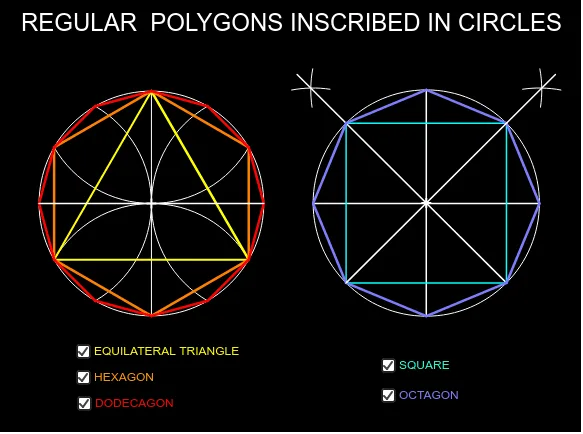
① This example demonstrates how to construct regular polygons (such as equilateral triangles, squares, etc.) inscribed in a given circle, showing that all vertices lie on the circle. ② Core mathematical concepts include the definition of regular polygons, properties of cyclic polygons, the relationship between central angles and side lengths, and symmetry in circle-polygon configurations. ③ Construction details: Based on the construction summary, the GeoGebra commands used include Circle, Line, OrthogonalLine, Intersect, Segment, and CircleArc. Objects such as A, B, c, C, D, etc., are created to build auxiliary lines and intersection points that determine the vertices of the regular polygon, with arcs and segments connecting them. ④ Suitable for middle and high school geometry classes, this interactive construction helps students visualize the inscribed property, explore geometric constructions, and understand the connection between circles and regular polygons. It is also useful for dynamic geometry exploration and mathematical inquiry.
GeoGebra Commands & Parameters
Circle(A, B) → cCircle(C, D) → dLine(A, xAxis) → aOrthogonalLine(A, a) → bIntersect(c, b, 2) → EIntersect(c, b, 1) → FSegment(E, F) → eCircle(F, A) → fIntersect(c, f, 2) → GIntersect(c, f, 1) → HCircleArc(F, H, G) → gSegment(E, H) → hSegment(H, G) → iSegment(G, E) → jCircle(E, A) → pIntersect(c, p, 1) → IIntersect(c, p, 2) → JCircleArc(E, I, J) → qSegment(E, J) → lSegment(J, H) → mSegment(H, F) → nSegment(F, G) → rSegment(G, I) → sSegment(I, E) → tIntersect(c, a, 1) → KIntersect(c, a, 2) → LCircle(K, A) → c_1Circle(L, A) → d_1Intersect(c, c_1, 2) → MIntersect(c, c_1, 1) → NIntersect(c, d_1, 1) → OIntersect(c, d_1, 2) → PCircleArc(K, N, M) → e_1CircleArc(L, O, P) → f_1Segment(E, O) → a_1Segment(O, J) → b_1Segment(J, L) → g_1Segment(L, H) → h_1Segment(H, P) → i_1Segment(P, F) → j_1Segment(F, N) → k_1Segment(N, G) → l_1Segment(G, K) → m_1Segment(K, I) → n_1Segment(I, M) → p_1Segment(M, E) → q_1Segment(K, L) → r_1OrthogonalLine(C, a) → s_1Intersect(d, s_1) → Q, RIntersect(d, a) → S, TCircle(S, 3) → t_1Circle(R, 3) → c_2Intersect(t_1, c_2, 1) → UCircle(T, 3) → d_2Intersect(c_2, d_2, 1) → VCircle(U, 0.5) → e_2Circle(V, 0.5) → f_2Intersect(c_2, f_2, 1) → WIntersect(d_2, f_2, 2) → ZIntersect(c_2, f_2, 2) → A_1Intersect(d_2, f_2, 1) → B_1Intersect(c_2, e_2, 2) → C_1Intersect(t_1, e_2, 1) → D_1Intersect(c_2, e_2, 1) → E_1Intersect(t_1, e_2, 2) → F_1CircleArc(T, Z, B_1) → g_2CircleArc(R, A_1, W) → h_2CircleArc(R, C_1, E_1) → k_2CircleArc(S, F_1, D_1) → p_2Intersect(g_2, h_2, 1) → G_1Line(U, C) → a_2Line(G_1, C) → b_2Intersect(d, b_2, 2) → H_1Intersect(d, a_2, 2) → I_1Intersect(e_2, a_2, 1) → J_1Intersect(f_2, b_2, 1) → K_1Segment(J_1, I_1) → i_2Segment(G_1, H_1) → j_2Segment(R, Q) → l_2Segment(S, T) → m_2Intersect(a_2, i_2) → L_1Intersect(a_2, i_2) → M_1Intersect(a_2, i_2) → N_1Intersect(a_2, i_2) → O_1Intersect(d, a_2, 1) → P_1Intersect(d, b_2, 1) → Q_1Segment(P_1, Q_1) → n_2Segment(Q_1, I_1) → q_2Segment(I_1, H_1) → r_2Segment(H_1, P_1) → s_2Segment(R, Q_1) → t_2Segment(Q_1, T) → a_3Segment(T, I_1) → b_3Segment(I_1, Q) → c_3Segment(Q, H_1) → d_3Segment(H_1, S) → e_3Segment(S, P_1) → f_3Segment(P_1, R) → g_3Intersect(g_2, h_2, 1) → R_1Line(C, R_1) → h_3Intersect(f_2, h_3, 2) → S_1Intersect(d, h_3, 1) → T_1Segment(S_1, T_1) → i_3