
Reflections over Two Parallel Lines
Loading the math board and drawing, please wait…
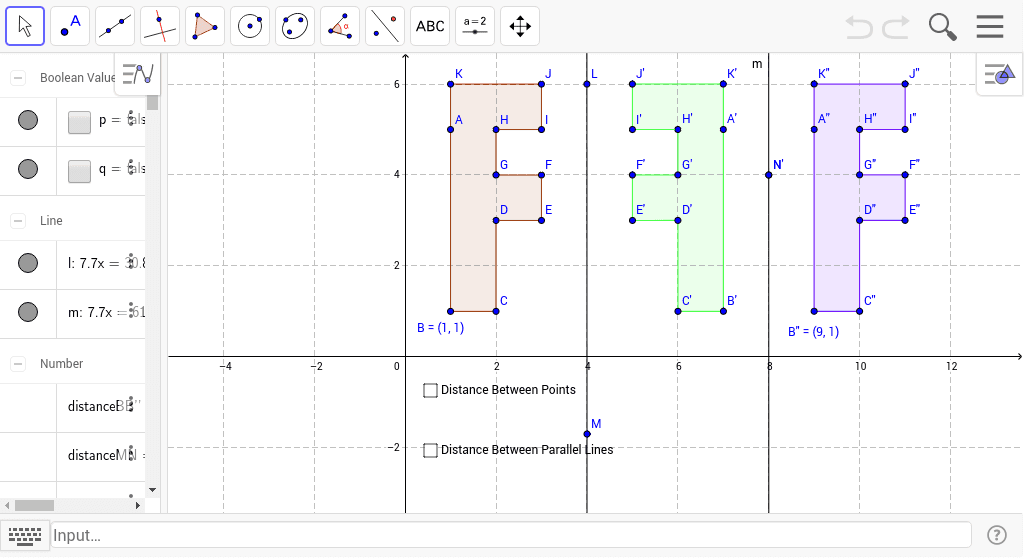
① This example demonstrates the geometric pattern created by repeatedly reflecting a figure across two parallel lines. ② Core concepts: reflection as a geometric transformation, properties of parallel lines, distance invariance, congruence and symmetry of polygons. ③ Construction highlights: Polygon to build the initial shape, Line to draw the two parallels, Mirror to perform the reflections, Distance to measure point‑to‑line distances; objects include vertices A‑K, polygon poly1 and its image poly1', parallel lines a and b, etc. ④ Suitable for middle‑school transformation lessons, high‑school analytic geometry review, and introductory GeoGebra animation projects.
GeoGebra Commands & Parameters
Polygon(A, B, K, C, D, E, F, G, H, I, J) → poly1, a, j, k, b, c, d, e, f, g, h, iLine(L, M) → lLine(N, l) → mMirror(A, l) → A'Mirror(B, l) → B'Mirror(C, l) → C'Mirror(D, l) → D'Mirror(E, l) → E'Mirror(F, l) → F'Mirror(G, l) → G'Mirror(H, l) → H'Mirror(I, l) → I'Mirror(J, l) → J'Mirror(K, l) → K'Polygon(A', B', K', C', D', E', F', G', H', I', J') → poly1', a', j', k', b', c', d', e', f', g', h', i'Mirror(N, m) → N'Mirror(A', m) → A''Mirror(B', m) → B''Mirror(C', m) → C''Mirror(D', m) → D''Mirror(E', m) → E''Mirror(F', m) → F''Mirror(G', m) → G''Mirror(H', m) → H''Mirror(I', m) → I''Mirror(J', m) → J''Mirror(K', m) → K''Polygon(A'', B'', K'', C'', D'', E'', F'', G'', H'', I'', J'') → poly1'', a'', j'', k'', b'', c'', d'', e'', f'', g'', h'', i''Distance(m, l) → nDistance(M, m) → distanceMmDistance(M, N) → distanceMNDistance(M, m) → oDistance(B, B'') → distanceBB''
AI Drawing Prompt Reference
Draw a polygon with vertices A, B, K, C, D, E, F, G, H, I, J, then reflect it twice over two parallel lines l and m to create a new polygon. First, draw a polygon with vertices A, B, K, C, D, E, F, G, H, I, J, and then draw two parallel lines l and m. Next, reflect each vertex of the polygon over line l to create a new polygon. Then, reflect the new polygon over line m to generate the final polygon. Finally, measure the distance between lines l and m, and the distances from point M to lines m and N.
The prompt above was compiled from the original drawing commands and is for reference only.