
Reflection Symmetry of an Isosceles Triangle
Loading the math board and drawing, please wait…
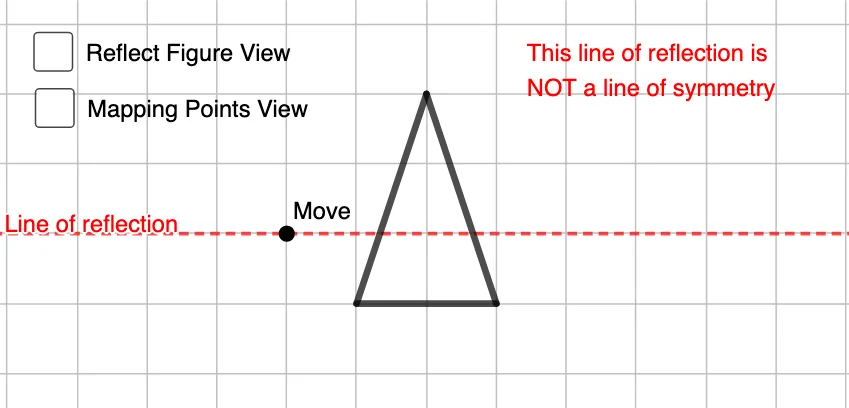
This example demonstrates the reflection symmetry of an isosceles triangle. Key mathematical concepts include reflection and symmetry. Using GeoGebra commands such as Point, Polygon, Mirror, etc., the construction of an isosceles triangle and its axis of symmetry is illustrated. Suitable for middle school and above students to learn geometric transformations.
GeoGebra Commands & Parameters
Point(xAxis) → APoint(xAxis) → CPoint(yAxis) → BPolygon(A, B, C) → t1, c, a, bCentroid(t1) → DCircle(D, 4) → dPoint(d) → ELine(E, D) → fPoint(c) → FMirror(F, f) → F'Point(c) → GMirror(G, f) → G'Point(b) → HMirror(H, f) → H'Mirror(A, f) → A'Mirror(B, f) → B'Mirror(C, f) → C'Polygon(A', B', C') → t1', c', a', b'
AI Drawing Prompt Reference
Create an isosceles triangle on a coordinate plane by choosing three points: two base endpoints arranged symmetrically and a third point connected to them to form a closed three-sided polygon. Determine a center-type point associated with the triangle and draw the line through this point to serve as the axis of symmetry. Reflect each of the triangle’s three vertices across this line to obtain the corresponding mirrored vertices. Connect the reflected vertices to form the reflected triangle, showing both the original triangle and its mirror image with respect to the symmetry axis.
The prompt above was compiled from the original drawing commands and is for reference only.