
Reflection of Point P on Triangle Sides
Loading the math board and drawing, please wait…
In collections
A Tour of Triangle Geometry
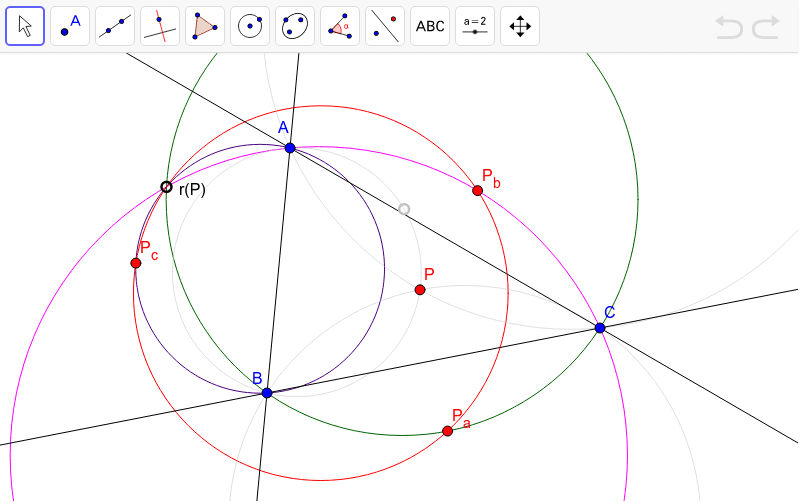
This example demonstrates the reflections of point P on the sides of triangle ABC, resulting in points Pa, Pb, and Pc. Key concepts include reflection transformations and circle properties. Using GeoGebra commands such as Line, Circle, Mirror, and Intersect, these reflections and related circles can be constructed. Suitable for high school geometry.
GeoGebra Commands & Parameters
Line(A, B) → aLine(B, C) → bLine(C, A) → cCircle(A, B, C) → dMirror(P, c) → P_bMirror(P, b) → P_aMirror(P, a) → P_cCircle(P_a, B, C) → eCircle(P_b, A, C) → fCircle(P_c, A, B) → gCircle(P_b, P_a, P_c) → hIntersect(e, f, 2) → DMirror(D, b) → D'Mirror(D, a) → D'_1Mirror(D, c) → D'_2Circle(D'_2, A, C) → kCircle(D', B, C) → pCircle(D'_1, A, B) → q
AI Drawing Prompt Reference
Draw a triangle and reflect a point P on each of its sides, labeling the reflections as Pa, Pb, and Pc. Create three circles with the triangle's vertices as centers and the distances between each pair of vertices as radii. Then, draw three more circles with centers at Pa, Pb, and Pc, each with the other two sides of the triangle as radii. Finally, draw a circle using Pa, Pb, and Pc as centers, and find the intersections of this circle with the other two circles. Use these intersection points as centers to draw three circles with the triangle's sides as radii.
The prompt above was compiled from the original drawing commands and is for reference only.