
Reflection in Pairs: Mirroring Polygons Across a Median Line
Loading the math board and drawing, please wait…
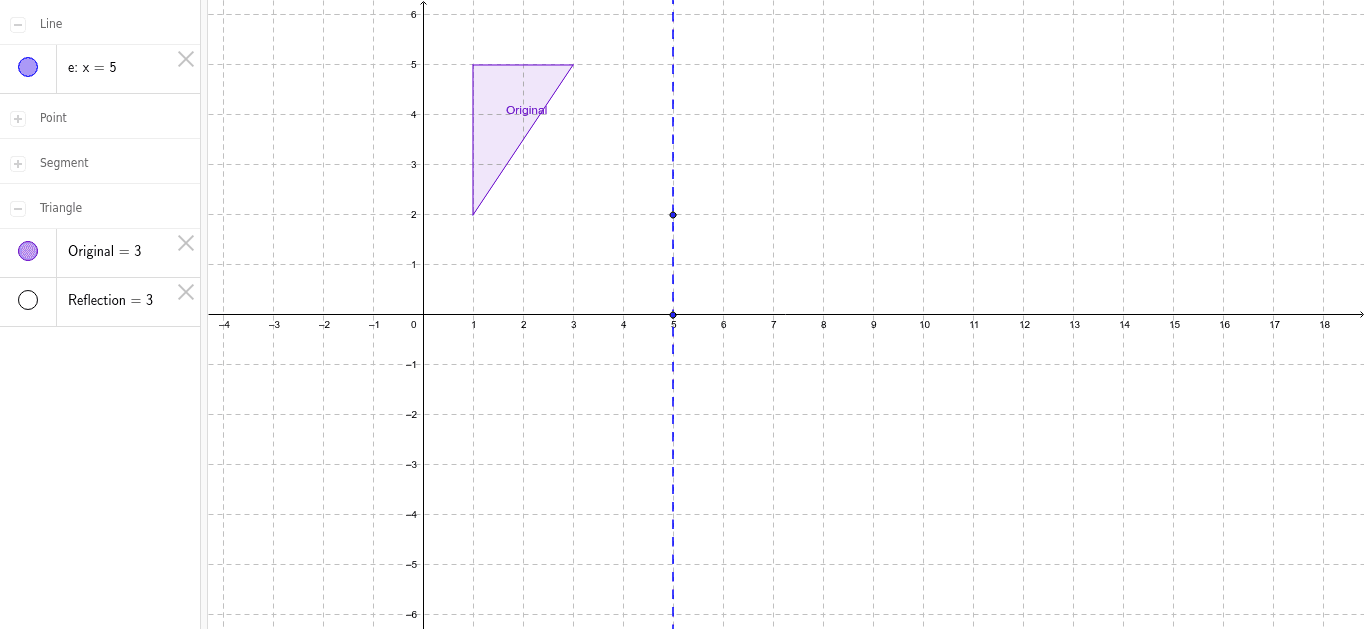
This GeoGebra activity demonstrates the reflection of a polygon (triangle) across a straight line, showing both the original and its mirror image simultaneously to visualize the geometric effect of axial symmetry. The core mathematical concepts include reflection (axial symmetry), special points such as midpoints, median lines, and properties of rhombi. The construction uses the Polygon command to create the original triangle, the Line command to define the reflection axis (median line), and the Mirror command to generate the reflected triangle across that line. Key objects include points A, B, C, the original polygon, the reflection axis (line c), and the reflected vertices A', B', C' with corresponding sides a', b', c'. This activity is suitable for middle or high school students learning geometric transformations, helping them understand distance preservation, symmetry, and the correspondence between original and reflected figures. It also serves as an introductory dynamic geometry exploration for teachers and learners.
GeoGebra Commands & Parameters
Polygon(A, B, C) → Original, c, a, bLine(F, G) → eMirror(A, e) → A'Mirror(B, e) → B'Mirror(C, e) → C'Polygon(A', B', C') → Reflection, c', a', b'
AI Drawing Prompt Reference
Draw a triangle and a straight line as the axis of symmetry, which passes through the midpoint of one side of the triangle and is perpendicular to that side. Reflect each of the three vertices of the triangle across this line to obtain three reflected points, then connect these points to form a new triangle, which is the mirror image of the original across the line. Use dashed lines or different colors to distinguish the original triangle from its reflection, and label the axis of symmetry.
The prompt above was compiled from the original drawing commands and is for reference only.