
Reflection Across Intersecting Lines
Loading the math board and drawing, please wait…
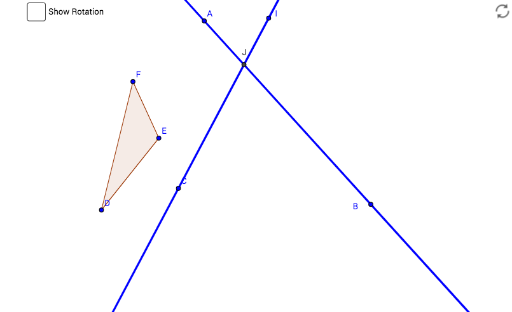
This example demonstrates the reflection transformation of a polygon across two intersecting lines and its properties. It involves core mathematical concepts such as reflection symmetry, function graphs, frequency distribution, circumcircle, scalene triangles, and volume calculations. The construction uses GeoGebra commands like Polygon, Vector, Translate, Line, Intersect, Mirror, Segment, Angle, and Rotate. Suitable for high school mathematics education, exploring the integration of transformation geometry and coordinate geometry.
GeoGebra Commands & Parameters
Polygon(D, E, F) → poly1, f, d, eVector(G, H) → uTranslate(D, u) → D'_1Translate(E, u) → E'_1Translate(F, u) → F'_1Polygon(D'_1, E'_1, F'_1) → poly1'_1, f'_1, d'_1, e'_1Line(A, B) → aLine(C, I) → bIntersect(a, b) → JMirror(D, b) → D'Mirror(E, b) → E'Mirror(F, b) → F'Polygon(D', E', F') → poly1', f', d', e'Mirror(D', a) → D''Mirror(E', a) → E''Mirror(F', a) → F''Polygon(D'', E'', F'') → poly1'', f'', d'', e''Segment(E, J) → cSegment(J, E'') → gAngle(E, J, E'') → αRotate(D, β, J) → D'_2Rotate(E, β, J) → E'_2Rotate(F, β, J) → F'_2Polygon(D'_2, E'_2, F'_2) → poly1'_2, f'_2, d'_2, e'_2