
Rectangular Prism by Kristina Craner
Loading the math board and drawing, please wait…
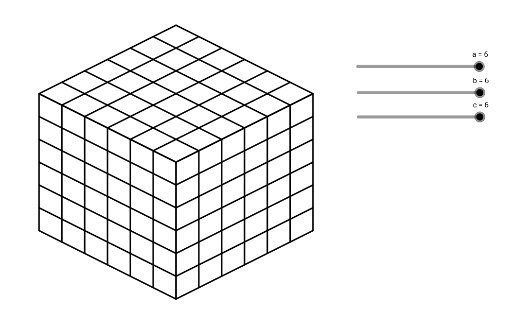
This example demonstrates the 3D shape of a rectangular prism and its basic properties. Core math concepts include solid geometry, coordinate geometry, and sequence construction using GeoGebra's Sequence command to generate objects a, b, c, list1 to list6 for building the prism's vertices and edges. Suitable for high school students learning solid geometry and coordinate geometry.
GeoGebra Commands & Parameters
Sequence(Segment[(n, a - n / 2), (n, ((-n)) / 2)], n, 0, b) → list1Sequence(Segment[(n + b, ((-b)) / 2 + n / 2), (n + b, ((-b)) / 2 + n / 2 + a)], n, 0, c) → list2Sequence(Segment[(0, a - n), (b, ((-b)) / 2 - n + a)], n, 0, a) → list3Sequence(Segment[(b, ((-b)) / 2 + n), (b + c, ((-b)) / 2 + n + c / 2)], n, 0, a) → list4Sequence(Segment[(n, ((-n)) / 2 + a), (n + c, c / 2 - n / 2 + a)], n, 0, b) → list5Sequence(Segment[(n, a + n / 2), (n + b, a + n / 2 - b / 2)], n, 0, c) → list6
AI Drawing Prompt Reference
Draw a 3D rectangular prism with a rectangular base and vertical sides. Construct the edges using six sets of parallel segments: first the four base edges, then the four top edges, and finally the vertical edges connecting corresponding vertices. Space the segments evenly to create a grid-like structure, emphasizing the prism's three dimensions and coordinate positions. The overall shape clearly shows length, width, and height, suitable for solid geometry instruction.
The prompt above was compiled from the original drawing commands and is for reference only.