
Rectangles on Triangle
Loading the math board and drawing, please wait…
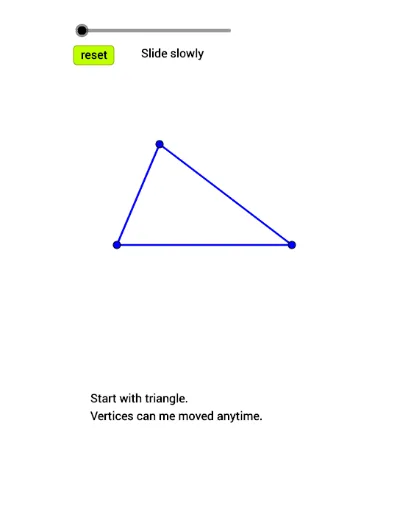
This example demonstrates the dynamic construction of rectangles within a triangle and the geometric relationships involved. It involves core math concepts like rectangles, probability, secant lines or secants, power functions, LCM and GCD, and quadrilaterals. The construction uses commands and objects such as Rectangle, Segment, OrthogonalLine, Polygon, LineBisector, Intersect, Angle, and If from GeoGebra. It is suitable for high school mathematics education, exploring geometric transformations and applications in probability and statistics.
GeoGebra Commands & Parameters
Rectangle1(C, B) → D, ERectangle1(A, C) → F, GRectangle1(B, A) → H, ISegment(A, B) → fSegment(B, C) → gSegment(C, A) → hOrthogonalLine(C, g) → kPolygon(B, D, E, C) → poly1, b, d, e, cPolygon(C, F, G, A) → poly2, c_1, f_1, g_1, aPolygon(A, H, I, B) → poly3, a_1, h_1, i, b_1Segment(F, F + (t6 * (E - F))) → jLineBisector(j) → n_2Segment(H, H + (t5 * (G - H))) → lLineBisector(l) → pSegment(D, D + (t4 * (I - D))) → mLineBisector(m) → qIntersect(q, n_2) → JIntersect(n_2, j) → KIntersect(p, l) → LIntersect(m, q) → MAngle(F, K, J) → αAngle(H, L, J) → βAngle(D, M, J) → γSegment(K, E) → rSegment(K, F) → sSegment(G, L) → k_1Segment(L, H) → l_1Segment(D, M) → m_1Segment(M, I) → n_1Segment(D, D + (t4 * (I - D))) → p_1If(t1 < 1, Segment[B, B + (t1 * (D - B))], If[t1 < 2, Segment[D, D + ((t1 - 1) * (E - D))], Segment[E, E + ((t1 - 2) * (C - E))]]) → q_1If(t2 < 1, Segment[C, C + (t2 * (F - C))], If[t2 < 2, Segment[F, F + ((t2 - 1) * (G - F))], Segment[G, G + ((t2 - 2) * (A - G))]]) → r_1If(t3 < 1, Segment[A, A + (t3 * (H - A))], If[t3 < 2, Segment[H, H + ((t3 - 1) * (I - H))], Segment[I, I + ((t3 - 2) * (B - I))]]) → s_1Segment(K3, K3 + (t7 * (J - K3))) → tSegment(L3, L3 + (t7 * (J - L3))) → i_1Segment(M3, M3 + (t7 * (J - M3))) → j_1