
Rectangles-Diagonals -Triangles
Loading the math board and drawing, please wait…
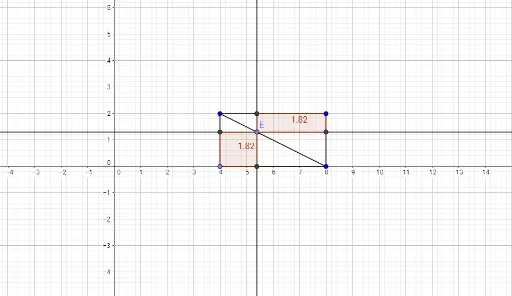
This example illustrates the relationship between the diagonals of rectangles and triangles. Key mathematical concepts include geometric construction, triangle properties, and coordinate geometry. Using GeoGebra commands such as Point, Segment, and OrthogonalLine, rectangles, diagonals, and related triangles are constructed. Suitable for middle school and above students to learn about geometry and triangle-related knowledge.
GeoGebra Commands & Parameters
Point(xAxis) → ASegment(A, B) → fSegment(B, C) → gSegment(D, C) → hSegment(D, A) → iSegment(D, B) → jPoint(j) → EOrthogonalLine(E, h) → kOrthogonalLine(E, i) → lIntersect(k, h) → FIntersect(l, g) → GIntersect(k, f) → HIntersect(l, i) → IPolygon(I, A, H, E) → poly1, i_1, a, h_1, ePolygon(F, E, G, C) → poly2, f_1, e_1, g_1, c
AI Drawing Prompt Reference
Draw a rectangle on a coordinate plane with vertices on the axes and horizontal lines. Connect the two diagonals of the rectangle. Pick a point on one diagonal, and from this point draw perpendicular lines to two sides of the rectangle. These perpendiculars intersect the sides and the other diagonal at several points. Connect these intersection points with the rectangle's vertices to form two triangular regions within the rectangle. The figure illustrates the geometric relationship between the rectangle's diagonals, perpendiculars, and the resulting triangles, useful for exploring area division and angle properties.
The prompt above was compiled from the original drawing commands and is for reference only.